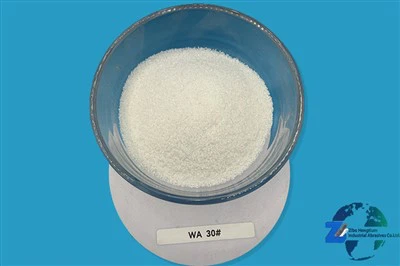
Hey there! As a white corundum supplier, I've seen a lot of folks scratching their heads when it comes to identifying high - quality white corundum. So, I thought I'd share some tips and tricks I've picked up over the years.
First off, let's talk about what white corundum is. It's a high - grade form of aluminum oxide, which is super hard and has excellent thermal and chemical stability. That's why it's used in a bunch of industries, like ceramics, electronics, and even the medical field. You can check out more about its applications in these industries here: White Corundum for Ceramics and Glass, White Corundum for Electronics and Optics, and White Corundum for Medical Industry.
Physical Appearance
One of the first things you can do is take a good look at the white corundum. High - quality white corundum usually has a pure white color. If it has a yellowish or grayish tint, that could be a sign of impurities. The particles should also be uniform in size. If you see a lot of large and small particles mixed together, it might not be the best quality.
When you touch it, it should feel smooth and not have any gritty or rough patches. A good way to test this is to rub a small amount between your fingers. If it feels like it's full of tiny sharp edges or if it leaves a residue on your fingers, there could be some issues with the manufacturing process or the presence of contaminants.
Chemical Composition
The chemical composition is crucial. White corundum is mainly made up of aluminum oxide (Al₂O₃). High - quality white corundum should have a very high percentage of Al₂O₃, usually above 99%. You can ask the supplier for a chemical analysis report. This report will tell you the exact percentages of different elements in the white corundum.
Other elements like sodium oxide (Na₂O), silicon dioxide (SiO₂), and iron oxide (Fe₂O₃) should be present in very small amounts. High levels of these impurities can affect the performance of white corundum in different applications. For example, too much iron oxide can cause discoloration in ceramics, and high sodium oxide content can reduce the thermal stability.
Hardness and Abrasion Resistance
White corundum is known for its hardness. You can do a simple scratch test to get an idea of its quality. Take a small piece of the white corundum and try to scratch a hard surface, like a glass plate. High - quality white corundum should be able to leave a scratch on the glass. If it can't, it might not be as hard as it should be.
In industries where abrasion resistance is important, like in grinding wheels, the white corundum needs to be able to withstand a lot of wear and tear. You can ask the supplier for information about the abrasion resistance of their white corundum. They might have data from tests that show how well it holds up under different abrasion conditions.


Particle Shape and Size Distribution
The shape of the white corundum particles can also tell you a lot about its quality. Spherical or near - spherical particles are generally better because they flow more easily and provide more consistent performance. Irregularly shaped particles can cause problems in some applications, like in powder metallurgy or when used as a filler.
The size distribution is also key. A narrow size distribution means that most of the particles are around the same size. This is important for applications where a specific particle size is required. For example, in some polishing applications, you need a very precise particle size to get a smooth finish. You can ask the supplier for a particle size analysis report, which will show you the distribution of particle sizes in the white corundum.
Thermal Properties
Since white corundum is used in many high - temperature applications, its thermal properties are a big deal. High - quality white corundum should have good thermal conductivity and low thermal expansion. This means that it can transfer heat effectively and won't crack or break when exposed to rapid temperature changes.
You can ask the supplier about the thermal conductivity and expansion coefficients of their white corundum. They might have data from thermal testing that shows how well it performs under different temperature conditions.
Purity and Contamination
Purity is really important when it comes to white corundum. As I mentioned earlier, high - quality white corundum should have a very high percentage of aluminum oxide and low levels of impurities. Contamination can come from a variety of sources, like the raw materials used in the manufacturing process or the equipment used to produce it.
Some common contaminants include heavy metals, which can be harmful in certain applications, especially in the medical and food industries. Make sure the supplier has a good quality control system in place to minimize contamination. They should be able to provide you with certificates of purity and test results to prove that their white corundum meets the required standards.
Supplier Reputation
Last but not least, the reputation of the supplier matters a lot. A reliable supplier will have a history of providing high - quality products and good customer service. You can check online reviews and ask for references from other customers. A good supplier will also be transparent about their manufacturing process, quality control measures, and testing procedures.
If you're looking for high - quality white corundum for your business, don't hesitate to reach out. We're here to help you find the right product for your specific needs. Whether you're in the ceramics, electronics, or medical industry, we've got you covered. Let's have a chat about your requirements and see how we can work together to get you the best white corundum on the market.
References
- ASTM International. (20XX). Standard Test Methods for Chemical Analysis of Aluminum Oxide and Alumina - Base Refractories.
- Ceramic Industry Association. (20XX). Guidelines for Selecting High - Quality Raw Materials for Ceramics.
- Electronics Manufacturers Alliance. (20XX). Technical Specifications for White Corundum in Electronic Applications.