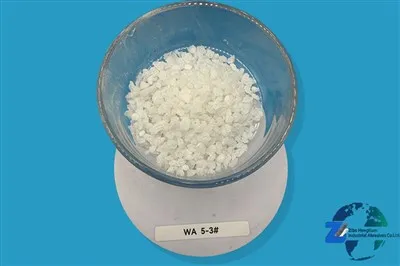
As a supplier of White Corundum for Refractory, I often encounter inquiries about the standard testing procedure for its density. Density is a crucial property of white corundum for refractory applications, as it can significantly impact the performance and quality of the final refractory products. In this blog post, I will delve into the standard testing procedure for the density of white corundum for refractory, providing a comprehensive overview for those interested in this field.
Understanding White Corundum for Refractory
Before we dive into the testing procedure, let's briefly understand what white corundum for refractory is. White corundum, also known as white fused alumina, is a high - purity aluminum oxide material produced by fusing high - quality bauxite in an electric arc furnace at high temperatures. It has excellent properties such as high hardness, good chemical stability, and high refractoriness, making it an ideal raw material for refractory products. You can find more information about our White Corundum for Refractory on our website.
Importance of Density Testing
The density of white corundum for refractory is an important parameter. A proper density ensures that the refractory material has the right structure and porosity. High - density white corundum can provide better mechanical strength and resistance to thermal shock, which are essential for refractory applications in high - temperature environments. On the other hand, an incorrect density may lead to issues such as poor insulation, reduced durability, and premature failure of the refractory products.
Standard Testing Procedure
1. Sample Preparation
The first step in the density testing procedure is sample preparation. It is essential to obtain a representative sample of the white corundum. The sample should be taken from different parts of the batch to ensure its representativeness. Usually, a sufficient amount of sample, around 100 - 200 grams, is collected. The sample is then dried in an oven at a temperature of about 105 - 110°C for 2 - 3 hours to remove any moisture. After drying, the sample is cooled in a desiccator to room temperature.
2. Measuring the Mass
Once the sample is prepared, the next step is to measure its mass. A precise analytical balance is used for this purpose. The balance should have an accuracy of at least 0.001 grams. The dried sample is placed on the balance, and its mass (m) is recorded.
3. Measuring the Volume
There are several methods to measure the volume of the white corundum sample. One of the most common methods is the pycnometer method.
- Pycnometer Selection: A pycnometer is a glass flask with a close - fitting ground - glass stopper with a capillary hole through it. The pycnometer should be clean and dry before use.
- Filling the Pycnometer with the Sample: The pycnometer is first weighed empty (m1). Then, the prepared white corundum sample is carefully transferred into the pycnometer, and the pycnometer with the sample is weighed (m2). The mass of the sample in the pycnometer is m = m2 - m1.
- Adding a Liquid: A liquid that does not react with the white corundum, such as distilled water or a suitable organic solvent, is added to the pycnometer containing the sample. The pycnometer is then carefully filled to the mark on the stopper, ensuring that there are no air bubbles. The pycnometer with the sample and the liquid is weighed (m3).
- Determining the Volume: The volume of the sample (V) can be calculated using the following formula. First, the mass of the liquid displaced by the sample is m4=(m1 + mass of liquid filled to the mark) - m3. The density of the liquid (ρl) is known. The volume of the liquid displaced, which is equal to the volume of the sample, is V = m4/ρl.
4. Calculating the Density
After obtaining the mass (m) and volume (V) of the sample, the density (ρ) of the white corundum for refractory can be calculated using the formula ρ = m/V. The result is usually expressed in grams per cubic centimeter (g/cm³).
5. Repeatability and Accuracy
To ensure the accuracy of the test results, the entire testing procedure should be repeated at least three times. The average value of the density is then calculated. The relative standard deviation (RSD) of the repeated measurements should be within an acceptable range, usually less than 2%. If the RSD is too high, it may indicate errors in the testing process, such as improper sample preparation or inaccurate measurement.
Other Applications of White Corundum
White corundum is not only used in refractory applications. It also has a wide range of uses in other fields. For example, it is used in the production of White Corundum for Ceramics and Glass. In ceramics, white corundum can improve the hardness and wear - resistance of ceramic products. In the glass industry, it can be used as a grinding and polishing material. Additionally, white corundum is also used in White Corundum for Other Applications, such as in the production of abrasive tools and high - performance coatings.
Conclusion
In conclusion, the standard testing procedure for the density of white corundum for refractory involves sample preparation, mass measurement, volume measurement, density calculation, and ensuring repeatability and accuracy. By following these steps, we can obtain reliable density values, which are crucial for assessing the quality of white corundum for refractory applications.
If you are interested in purchasing high - quality white corundum for refractory or have any questions about our products, please feel free to contact us for procurement discussions. We are committed to providing you with the best products and services.


References
- ASTM International. (Year). Standard Test Methods for Bulk Density (“Unit Weight”), Yield, and Air Content (Gravimetric) of Concrete. ASTM C138/C138M - XX.
- ISO Standards. (Year). ISO XX:XXXX - Determination of Density of Refractory Materials.