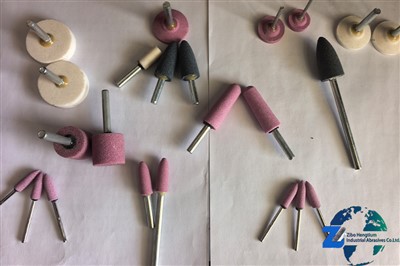
Hey there! I'm a supplier of Mounted Points for Hardware Tools, and today I wanna chat about the surface finish you can achieve with these little wonders.
First off, let's get a basic understanding of what mounted points are. They're small, abrasive tools that are used for a variety of tasks like grinding, deburring, and polishing in the hardware tool industry. They come in different shapes, sizes, and abrasive materials, which all play a role in the surface finish they can produce.


Surface Finish Basics
Surface finish is all about how smooth or rough the surface of a material is after being worked on. It's usually measured in terms of roughness average (Ra), which is the arithmetic average of the absolute values of the surface profile deviations from the mean line. A lower Ra value means a smoother surface finish.
The surface finish you want depends on the application. For example, if you're making a precision part for a machine, you'll probably want a very smooth finish to ensure proper fit and function. On the other hand, if you're just doing some general deburring on a piece of metal, a slightly rougher finish might be okay.
Factors Affecting Surface Finish with Mounted Points
There are several factors that can affect the surface finish you achieve with mounted points. Let's take a look at some of the most important ones.
Abrasive Material
The type of abrasive material used in the mounted point is a major factor. Different abrasives have different hardness, sharpness, and cutting abilities. For example, aluminum oxide is a common abrasive that's great for general-purpose grinding and polishing. It's relatively inexpensive and can produce a decent surface finish on a variety of materials.
Silicon carbide, on the other hand, is harder and sharper than aluminum oxide. It's often used for grinding and polishing hard materials like ceramics and carbides. Diamond abrasives are the hardest and sharpest of all, and they're used for very fine polishing and finishing of hard materials.
Grit Size
The grit size of the abrasive is another important factor. Grit size refers to the size of the abrasive particles. A smaller grit size means smaller particles, which can produce a smoother surface finish. For example, a 220-grit mounted point will produce a smoother finish than a 60-grit mounted point.
However, using a very fine grit size can also be time-consuming and may not be necessary for all applications. You need to choose the right grit size based on the material you're working on and the surface finish you want to achieve.
Mounted Point Shape
The shape of the mounted point can also affect the surface finish. Different shapes are designed for different applications. For example, a cylindrical mounted point is great for general-purpose grinding and polishing, while a cone-shaped mounted point is better for getting into tight spaces and doing detailed work.
The shape of the mounted point can also affect the way it contacts the surface of the material. A flat-mounted point will contact the surface more evenly, which can produce a smoother finish. A pointed-mounted point, on the other hand, will concentrate the cutting force at the tip, which can be useful for removing material quickly but may not produce as smooth a finish.
Operating Parameters
The operating parameters, such as speed, pressure, and feed rate, also play a role in the surface finish. If you run the mounted point too fast, it can generate too much heat and cause the surface to become rough or even damaged. On the other hand, if you run it too slow, it may not cut effectively and you won't get the desired surface finish.
The pressure you apply when using the mounted point is also important. If you apply too much pressure, it can cause the abrasive to break down too quickly and produce a rough finish. If you apply too little pressure, the mounted point may not cut effectively.
Surface Finish for Different Materials
Now, let's take a look at the surface finish you can achieve with mounted points on different materials.
Metal
When it comes to metal, mounted points can be used for a variety of tasks, from rough grinding to fine polishing. For example, if you're working on carbon steel, you can use a Mounted Points for Carbon Steel Polishing to achieve a smooth, shiny finish.
The surface finish you can achieve on metal depends on the type of metal, the abrasive material and grit size you use, and the operating parameters. Generally, you can achieve a Ra value of around 0.4 to 1.6 micrometers on metal surfaces with the right mounted point and operating conditions.
Wood
Mounted points can also be used for wood grinding and polishing. Mounted Points for Wood Grinding and Polishing are designed to remove material quickly and produce a smooth surface finish on wood.
The surface finish you can achieve on wood depends on the type of wood, the grit size of the mounted point, and the operating parameters. Generally, you can achieve a smooth, even finish on wood surfaces with a Ra value of around 3.2 to 6.3 micrometers.
Ductile Iron
Ductile iron is a type of cast iron that's known for its high strength and ductility. When polishing ductile iron, you need to use a mounted point that's designed for this specific material. Mounted Points for Ductile Iron Polishing can help you achieve a smooth, uniform surface finish on ductile iron.
The surface finish you can achieve on ductile iron depends on the abrasive material and grit size you use, as well as the operating parameters. Generally, you can achieve a Ra value of around 0.8 to 3.2 micrometers on ductile iron surfaces.
Tips for Achieving the Best Surface Finish
Here are some tips to help you achieve the best surface finish with mounted points:
- Choose the right mounted point: Make sure you choose a mounted point that's designed for the material you're working on and the surface finish you want to achieve. Consider the abrasive material, grit size, and shape of the mounted point.
- Use the right operating parameters: Follow the manufacturer's recommendations for speed, pressure, and feed rate. This will help you get the best results and avoid damaging the surface of the material.
- Keep the mounted point clean: A dirty or clogged mounted point won't cut effectively and may produce a rough surface finish. Make sure you clean the mounted point regularly to keep it in good condition.
- Inspect the surface finish regularly: As you're working, stop periodically to inspect the surface finish. This will help you make any necessary adjustments to the operating parameters or the mounted point.
Conclusion
In conclusion, mounted points are versatile tools that can be used to achieve a variety of surface finishes on different materials. By understanding the factors that affect surface finish and following the tips I've shared, you can get the best results with your mounted points.
If you're in the market for high-quality Mounted Points for Hardware Tools, I'd love to chat with you. Whether you need them for carbon steel polishing, wood grinding, or ductile iron polishing, we've got the right products for you. Just reach out, and we can start discussing your specific needs and how we can help you achieve the perfect surface finish for your projects.
References
- Smith, J. (2020). Abrasive Tools and Their Applications. Industrial Tooling Journal.
- Johnson, A. (2019). Surface Finish Measurement and Control. Manufacturing Technology Review.