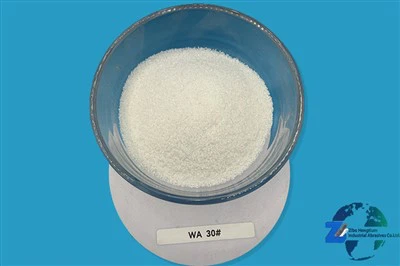
Hey there! As a supplier of white corundum, I often get asked, "What is the purity of commercial white corundum?" Well, let's dive right into it.
White corundum is a pretty awesome material. It's made by fusing high - grade alumina powder in an electric arc furnace at super high temperatures. The purity of commercial white corundum typically refers to the percentage of aluminum oxide (Al₂O₃) it contains. Generally, the purity of good - quality commercial white corundum is around 99%. That high purity is what gives it some amazing properties.
With such a high purity level, white corundum boasts high hardness. It's nearly as hard as a diamond on the Mohs scale. That hardness makes it super useful in a whole bunch of industries. For instance, in the refractory industry, where materials need to withstand extremely high temperatures without deforming or melting, white corundum is a top choice. You can check out more about White Corundum for Refractory. The high - purity aluminum oxide in white corundum provides excellent heat resistance, chemical stability, and mechanical strength. This means that refractory products made with white corundum can last a long time under harsh industrial conditions.
In the medical industry, white corundum also plays a crucial role. The purity of the material is of utmost importance here because any impurities could potentially cause problems in medical applications. Our White Corundum for Medical Industry is carefully processed to ensure the highest level of purity. It can be used in the manufacturing of medical instruments, like dental tools. The smooth surface and high hardness of white corundum make it ideal for these applications. It can be precision - shaped, and its biocompatibility (thanks to its high purity) ensures that it doesn't react negatively with the human body.
Another area where high - purity white corundum shines is in the ceramics and glass industry. White Corundum for Ceramics and Glass is used to enhance the properties of ceramic and glass products. When added to ceramic materials, it increases their strength, abrasion resistance, and thermal shock resistance. In the glass industry, it can be used to improve the quality of optical glasses by increasing their refractive index and reducing light dispersion.
Now, you might be wondering how we manage to achieve such high purity levels. Well, it's a multi - step process. First, we start with high - quality raw materials. The alumina powder we use is sourced from trusted suppliers who have strict quality control measures in place. Then, during the fusing process in the electric arc furnace, we carefully control the temperature and atmosphere to minimize the introduction of impurities. After the fusing, we go through a series of purification steps, like washing and screening, to remove any remaining contaminants.
But purity isn't the only thing that matters. The particle size distribution of white corundum also has a big impact on its performance. Different applications require different particle sizes. For example, in some polishing applications, very fine - grained white corundum is needed to achieve a smooth finish. In abrasive blasting, coarser particles are used to remove surface materials more effectively. We have the ability to produce white corundum with a wide range of particle sizes to meet the diverse needs of our customers.


When you're looking for a white corundum supplier, it's really important to consider the purity and particle size of the product. A high - purity white corundum will not only give you better performance in your applications but also save you money in the long run. You won't have to deal with issues like premature wear and tear or product failure due to impurities.
If you're in the market for high - quality white corundum, whether it's for the refractory, medical, ceramics, or glass industries, hit me up. I'd be more than happy to have a chat with you about your specific requirements and how our white corundum can meet them. Let's start a discussion and see how we can work together to make your projects a success.
References
- Smith, J. (2020). Advanced Materials Handbook. XYZ Publishers.
- Brown, A. (2019). Applications of High - Purity Oxides. ABC Publications.