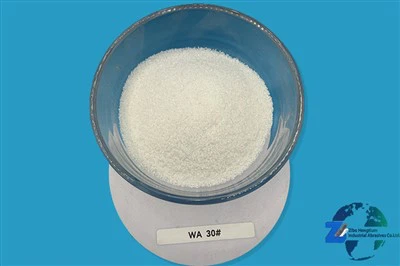
What is the thermal conductivity of white corundum for refractory?


As a supplier of White Corundum for Refractory, I often get asked about the thermal conductivity of this remarkable material. Thermal conductivity is a crucial property, especially in refractory applications where materials are exposed to high - temperature environments. In this blog, I'll delve into the thermal conductivity of white corundum for refractory, exploring its significance, factors affecting it, and how it compares to other materials.
Understanding Thermal Conductivity
Thermal conductivity, denoted by the symbol k, is a measure of a material's ability to conduct heat. It is defined as the quantity of heat (Q) transmitted through a unit thickness (L) of a material in a direction normal to a surface of unit area (A) due to a unit temperature gradient (∆T). Mathematically, it can be expressed using Fourier's law of heat conduction: (Q = - kA\frac{\Delta T}{L}). A high thermal conductivity means that the material can transfer heat quickly, while a low thermal conductivity implies that it is a good thermal insulator.
Thermal Conductivity of White Corundum for Refractory
White corundum, also known as white fused alumina, is a high - purity aluminum oxide (Al₂O₃) material. For refractory applications, its thermal conductivity typically ranges from about 20 - 30 W/(m·K) at room temperature. However, this value can change significantly with temperature. As the temperature increases, the thermal conductivity of white corundum generally decreases. At high temperatures, around 1000 - 1500°C, the thermal conductivity may drop to values between 5 - 10 W/(m·K).
This behavior is due to the complex interplay of phonon and electron conduction mechanisms in the material. At low temperatures, phonons (quantized lattice vibrations) are the main carriers of heat. As the temperature rises, the scattering of phonons by lattice defects, impurities, and other phonons increases, which reduces their mean free path and thus the thermal conductivity.
Significance in Refractory Applications
In refractory applications, the thermal conductivity of white corundum plays a vital role. In some cases, a relatively high thermal conductivity can be beneficial. For example, in applications where rapid heat transfer is required, such as in some industrial furnaces where efficient heating or cooling is necessary, white corundum can help to quickly transfer heat through the refractory lining.
On the other hand, in applications where thermal insulation is the primary concern, the decrease in thermal conductivity at high temperatures is advantageous. Refractory linings made of white corundum can help to reduce heat loss from the furnace, improving energy efficiency and reducing operating costs.
Factors Affecting the Thermal Conductivity of White Corundum for Refractory
- Purity: Higher purity white corundum generally has a higher thermal conductivity. Impurities can act as scattering centers for phonons, reducing their mean free path and thus the thermal conductivity. As a supplier, we ensure that our White Corundum for Refractory has a high level of purity to maintain its excellent thermal properties.
- Porosity: The presence of pores in the white corundum refractory can significantly affect its thermal conductivity. Pores act as barriers to heat transfer, reducing the effective cross - sectional area for heat conduction. A more porous material will have a lower thermal conductivity compared to a dense one.
- Crystal Structure: The crystal structure of white corundum can also influence its thermal conductivity. Well - ordered crystal structures generally allow for more efficient phonon propagation, resulting in higher thermal conductivity.
Comparison with Other Refractory Materials
When compared to other common refractory materials, white corundum has some unique thermal conductivity characteristics. For example, compared to fireclay refractories, which typically have a thermal conductivity in the range of 1 - 2 W/(m·K) at room temperature, white corundum has a much higher thermal conductivity. This makes white corundum more suitable for applications where higher heat transfer rates are needed.
Silicon carbide (SiC) refractories, on the other hand, have a very high thermal conductivity, often exceeding 100 W/(m·K) at room temperature. However, white corundum is more chemically stable and less prone to oxidation at high temperatures, which makes it a better choice in some oxidizing environments.
Other Applications of White Corundum
Apart from refractory applications, white corundum has a wide range of other uses. Our White Corundum for Electronics and Optics is used in the electronics industry for its high electrical insulation and optical transparency properties. In the medical field, White Corundum for Medical Industry is utilized due to its biocompatibility and high wear resistance.
Conclusion
The thermal conductivity of white corundum for refractory is a complex and important property that depends on various factors such as temperature, purity, porosity, and crystal structure. Its unique thermal conductivity characteristics make it a versatile material for a wide range of refractory applications, offering both efficient heat transfer and thermal insulation capabilities depending on the specific requirements.
If you are in the market for high - quality white corundum for refractory or other applications, we would be delighted to have a discussion with you. Our team of experts can provide you with detailed information about the properties of our products and help you select the most suitable material for your needs. Feel free to reach out to us for procurement and further technical discussions.
References
- Klemens, P. G. "Thermal conductivity and lattice vibrational modes." Solid State Physics 7 (1958): 1 - 98.
- Touloukian, Y. S., and E. H. Buyco, eds. Thermophysical Properties of Matter: Thermal Conductivity. Vol. 11. IFI/Plenum, 1970.
- Schneider, H. P., S. W. Dietzel, and J. R. Young. Refractories Handbook. Wiley - VCH, 2008.