

Can a simple grain change the surface of a product?
❓Does particle shape decide the finish?
- Yes, shape sculpts the surface.
Garnet is a family of natural silicate minerals used as abrasives, ranging from coarse grits (~16 mesh / 1.2 mm) to fine powders (~400 mesh / 38 µm).
- Garnet for Polishing: Typically 200–400 mesh (d50 ≈ 10–40 µm) or finer, particles are sub-angular to nearly equiaxed-providing both cutting action and gentleness for removing micro-defects without substrate damage.
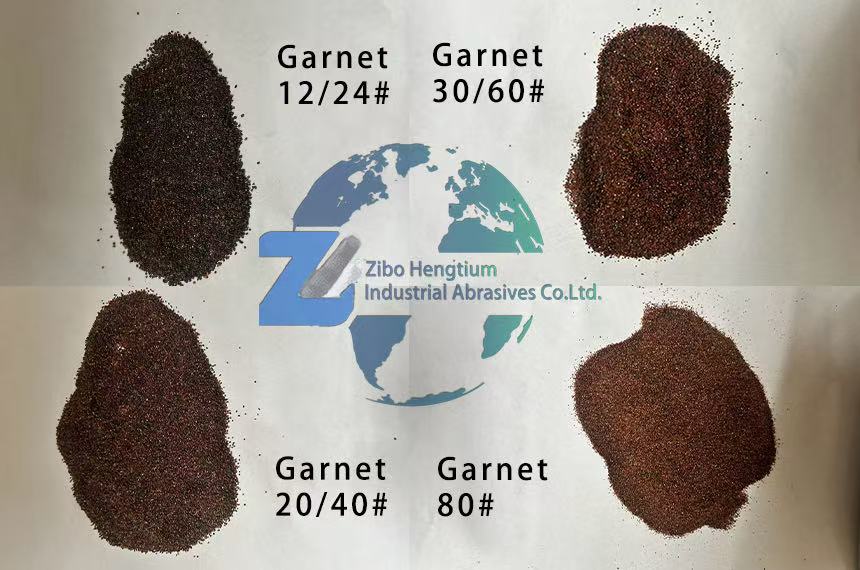
- Garnet for Blasting: Typically 30–120 mesh (d50 ≈ 125–425 µm), with angular morphology and high impact energy suitable for rust and coating removal and for creating a controlled anchor profile for paints/coatings.
❓Will chemistry and mineralogy sway outcomes?
- Absolutely, composition controls performance.
The Mohs Hardness of Garnet Sand is 6.5–7.5, favorable fracture behavior and relatively low dust generation make it ideal. Variants (almandine vs. pyrope/andradite mixes) affect sharpness, friability, dust levels and recyclability.
Polishing:
Fine garnet powders perform micro-cutting and gentle frictional polishing to remove defects and produce uniform micro-roughness (lower Ra) for metals, stone and glass.
Blasting:
Coarse garnet imparts a controlled anchor profile for coatings via high-impact collisions and tends to generate less secondary contamination.
Verification:
laser PSD, SEM morphology, XRF chemistry, dust index, Ra profilometry, coating adhesion peel/tensile tests.
❓Can the right garnet reduce rework?
- Yes, fewer defects means fewer fixes.
Low dust & debris (health & cleanliness):
Garnet tends to fracture into larger fragments rather than generate abundant fine dust-reducing inhalable particulates and cleaning downtime. Tests: dust-size distribution & workplace air sampling (PM2.5/PM10).
Recyclability (cost saving):
Good wear properties allow Garnet for Sandblasting to be reused 2–5 cycles depending on contamination-lower lifecycle cost vs. glass beads/steel grit. Tests: post-cycle PSD & hardness/surface energy tests.
Controlled anchor profile (better coating adhesion):
Proper grit size and blast parameters deliver anchor depths ~25–75 µm, improving coating longevity (aligned with SSPC/NACE metrics). Tests: surface profilometry, coating peel/tensile tests.
Polish consistency (appearance & function):
Polishing garnet yields stable Ra reductions and shortens final polishing stages. Tests: profilometry, gloss measurements.
❓Do metrics prove the choice?
- Data confirms garnet's value.
Typical Parameters & Tests (examples, customizable)
1. Chemistry (typical):
Garnet minerals vary-Al₂O₃ content ~20–45% depending on species; SiO₂/Fe₂O₃ depend on source-COA provides actual values.
2. Mechanical:
Mohs 6.5–7.5; true density 3.5–4.1 g/cm³ (varies by garnet).
3. Sizes available:
30 / 40 / 80 / 120 / 200 / 400 mesh (or equivalent µm/d50).
4. Tests available:
laser PSD, XRF chemistry, SEM morphology, dust generation, blast-cycle recyclability, coating adhesion/peel, Ra profilometry.
❓Can real projects illustrate the benefit?
- Yes, customer cases make it tangible.
At a recent exhibition, we met a shipyard that purchased and used our 40-mesh Garnet Blasting instead of glass microspheres. This improved sandblasting efficiency by about 12%, significantly reduced secondary contaminants, and improved coating adhesion test (tensile peel) by 15%.
❓Do you get technical backup after purchase?
- Yes, our lab and field teams support you.
We provide wholesalers, coating shops and fabricators with:
Free samples & pilot trials (blast benches, polishing benches).
PSD & recyclability consulting (optimize for contaminant types/coating systems and cycles).
H&S support (dust control recommendations, respiratory protection guidance).
Third-party testing coordination (air sampling, ICP).
Long-term partners can access priority scheduling, price protection and dedicated inventory.


