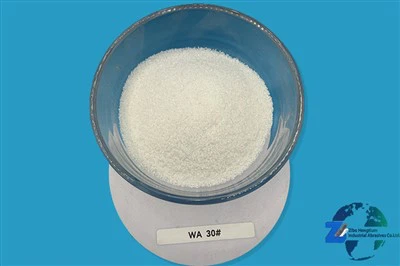
White corundum powder, a high - quality abrasive and refractory material, is well - known for its wide range of applications in various industries. As a white corundum powder supplier, I often get asked about its potential uses in the printing industry. In this blog, we will explore whether white corundum powder can be used in the printing industry and analyze the feasibility from multiple aspects.
Properties of White Corundum Powder
Before delving into its application in the printing industry, let's first understand the main properties of white corundum powder. White corundum powder is made from high - quality alumina powder through high - temperature melting and crystallization. It has a series of excellent physical and chemical properties.
- High Hardness: White corundum powder has a high Mohs hardness, usually around 9. This makes it a very effective abrasive material, capable of quickly and efficiently removing surface impurities and oxides.
- Good Chemical Stability: It is resistant to acid and alkali corrosion, and has good chemical stability under normal conditions. This property ensures that it can maintain its performance in different chemical environments.
- High Purity: The content of alumina ($Al_2O_3$) in white corundum powder is generally above 99%, which means it has few impurities and can provide a pure and stable performance.
- Uniform Particle Size Distribution: The particle size of white corundum powder can be precisely controlled, and it has a relatively uniform particle size distribution. This is crucial for applications that require high precision.
Potential Applications in the Printing Industry
1. Printing Plate Preparation
In the process of printing plate preparation, the surface of the printing plate needs to be treated to improve its printing performance. White corundum powder can be used for surface roughening of the printing plate. By using white corundum powder for sandblasting treatment, the surface of the printing plate can form a fine and uniform rough structure. This rough surface can increase the adhesion of the ink, making the ink transfer more evenly during the printing process and improving the clarity and quality of the printed image. For example, in offset printing, a well - roughened printing plate can better hold the ink and water balance, reducing the occurrence of ink splashing and color unevenness. You can find high - quality white corundum powder suitable for surface processing at White Corundum Powder for Surface Processing.
2. Cleaning of Printing Equipment
Printing equipment, such as rollers, cylinders, and ink ducts, will accumulate a large amount of ink, paper dust, and other impurities during long - term use. These impurities can affect the normal operation of the equipment and the quality of the printed products. White corundum powder can be used as a cleaning agent for these parts. Due to its high hardness and abrasive properties, it can effectively remove stubborn dirt and residues on the surface of the equipment. When using white corundum powder for cleaning, it can be made into a cleaning slurry and applied to the surface of the equipment through a specific cleaning process. This method can not only clean the equipment thoroughly but also avoid damage to the equipment surface because the particle size of white corundum powder can be selected according to the material and structure of the equipment.
3. Ink Additive
In theory, white corundum powder can also be used as an additive in ink. Adding a small amount of white corundum powder to the ink can improve the abrasion resistance and scratch resistance of the printed matter. When the printed matter is rubbed or scratched during use, the white corundum powder particles in the ink can play a protective role, reducing the damage to the ink layer. However, this application requires strict control of the amount and particle size of white corundum powder added. If the amount is too large, it may affect the fluidity and drying performance of the ink, and if the particle size is not appropriate, it may cause clogging of the printing nozzle or affect the smoothness of the printed surface.
Challenges and Limitations
Although white corundum powder has potential applications in the printing industry, there are also some challenges and limitations that need to be considered.
1. Cost
White corundum powder is a relatively high - cost material compared to some traditional materials used in the printing industry. The production process of white corundum powder requires high - temperature melting and other energy - intensive steps, which leads to a relatively high price. For some printing enterprises with tight cost budgets, the use of white corundum powder may increase the production cost significantly.
2. Compatibility
When using white corundum powder in the printing process, its compatibility with other materials needs to be considered. For example, when used as an ink additive, it needs to be compatible with the resin, solvent, and other components in the ink to ensure the stability and performance of the ink. In the process of cleaning printing equipment, it also needs to be compatible with the material of the equipment to avoid corrosion or damage to the equipment.
3. Environmental Impact
The production and use of white corundum powder may have certain environmental impacts. The high - temperature melting process in the production of white corundum powder consumes a large amount of energy and may produce some pollutants. In addition, if the waste containing white corundum powder generated during the printing process is not properly treated, it may also cause environmental pollution.
Comparison with Other Materials
In the printing industry, there are already many materials used for similar purposes. Let's compare white corundum powder with some common materials.
1. Compared with Silica Powder
Silica powder is also commonly used in the printing industry, especially in the field of ink additives. Silica powder has good light - scattering properties and can improve the gloss and opacity of the ink. However, compared with white corundum powder, silica powder has lower hardness and abrasion resistance. If the printed matter needs to have high abrasion resistance, white corundum powder may be a better choice.


2. Compared with Alumina Oxide Nanoparticles
Alumina oxide nanoparticles are also used in some high - end printing applications. They have small particle sizes and high surface activity, which can improve the performance of the ink and the printing plate. However, the production cost of alumina oxide nanoparticles is relatively high, and their dispersion in the system is more difficult. White corundum powder has a relatively lower cost and better dispersion performance in some cases.
Conclusion
In general, white corundum powder has certain potential applications in the printing industry, such as in printing plate preparation, cleaning of printing equipment, and as an ink additive. However, due to the challenges and limitations such as cost, compatibility, and environmental impact, its large - scale application in the printing industry still needs further exploration and improvement.
As a white corundum powder supplier, we are committed to providing high - quality products and technical support. If you are interested in using white corundum powder in your printing business or have any questions about its application, please feel free to contact us for procurement and negotiation. We can provide you with different specifications of white corundum powder, including those suitable for surface processing White Corundum Powder for Surface Processing, refractory White Corundum Powder for Refractory, and electrooptics White Corundum Powder for ELectrooptics.
References
- "Handbook of Abrasive Technology", CRC Press.
- "Printing Technology Principles and Applications", Wiley - Blackwell.
- Research papers on the application of inorganic materials in the printing industry from academic journals such as "Journal of Printing Science and Technology".