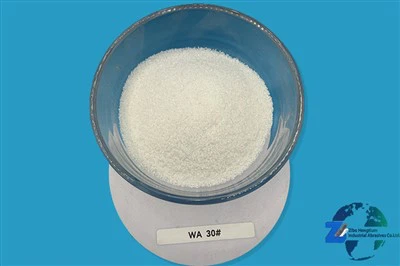
Hey there! As a white corundum supplier, I often get asked all sorts of questions about this amazing material. One question that pops up quite a bit is, "What is the Poisson's ratio of white corundum?" Well, let's dive right into it and break it down in a way that's easy to understand.
First off, let's talk about what Poisson's ratio actually means. In simple terms, Poisson's ratio is a measure of how a material responds to being stretched or compressed. When you pull on a material, it usually gets longer in the direction you're pulling, but it also gets thinner in the directions perpendicular to the pull. Poisson's ratio is the ratio of the transverse strain (the change in thickness) to the axial strain (the change in length).
Now, when it comes to white corundum, it's a super - hard and versatile material. White corundum is mainly made up of aluminum oxide (Al₂O₃), and it's known for its high purity, hardness, and good chemical stability. These properties make it suitable for a wide range of applications, from White Corundum for Electronics and Optics to White Corundum for Ceramics and Glass and White Corundum for Other Applications.
The Poisson's ratio of white corundum typically falls in the range of about 0.22 - 0.28. This value can vary a bit depending on factors like the manufacturing process, the purity of the white corundum, and the specific crystal structure. For instance, if the white corundum has a higher purity, it might have a more consistent Poisson's ratio within that range.
Let's think about why this Poisson's ratio is important. In applications where white corundum is used as an abrasive, understanding its Poisson's ratio helps in predicting how the material will deform under pressure. When you're using white corundum in a grinding or polishing operation, the material is subjected to forces. Knowing the Poisson's ratio allows engineers and manufacturers to design better - performing tools. If the Poisson's ratio is too high, the abrasive grains might deform too much and lose their cutting ability quickly. On the other hand, if it's too low, the grains might be too brittle and break apart prematurely.


In the electronics and optics industry, white corundum is used in things like semiconductor manufacturing and optical lens polishing. Here, the Poisson's ratio affects how the material behaves during precision machining processes. A stable Poisson's ratio ensures that the white corundum can be used to create smooth and accurate surfaces, which is crucial for high - performance electronic components and optical devices.
When it comes to ceramics and glass applications, white corundum is often added to improve the strength and wear resistance of these materials. The Poisson's ratio of white corundum plays a role in how well it integrates with the ceramic or glass matrix. If the Poisson's ratios of the white corundum and the matrix material are well - matched, it can lead to a more homogeneous and durable composite material.
Now, let's talk a bit about how the Poisson's ratio is measured. Scientists usually use specialized equipment like strain gauges to measure the axial and transverse strains of a white corundum sample under a known load. They apply a force to the sample and measure the changes in length and thickness simultaneously. By dividing the transverse strain by the axial strain, they can calculate the Poisson's ratio.
It's also important to note that the Poisson's ratio can change with temperature. As the temperature increases, the atomic bonds in white corundum start to loosen up a bit. This can cause the material to expand and contract more easily, which in turn affects the Poisson's ratio. In high - temperature applications, like in some industrial furnaces where white corundum is used as a refractory material, engineers need to take this temperature - dependent change in Poisson's ratio into account.
Another factor that can influence the Poisson's ratio is the presence of impurities. Even small amounts of impurities can disrupt the crystal structure of white corundum and change its mechanical properties, including the Poisson's ratio. That's why at our company, we pay a lot of attention to the purity of our white corundum. We use advanced purification processes to ensure that our white corundum has a consistent and reliable Poisson's ratio, which is essential for our customers' applications.
If you're in the market for high - quality white corundum, whether it's for electronics, ceramics, or other applications, we've got you covered. Our white corundum is carefully manufactured to meet the highest standards. We offer a range of particle sizes and purities to suit different needs. And because we understand the importance of the Poisson's ratio and other mechanical properties, you can trust that our product will perform as expected.
Whether you're an engineer looking for the perfect abrasive for your next project, a manufacturer in the ceramics or glass industry, or someone in the electronics and optics field, our white corundum can be a great choice. We're always happy to work with our customers to understand their specific requirements and provide the best - fitting solution.
If you're interested in learning more about our white corundum products or have any questions about the Poisson's ratio or other properties, don't hesitate to reach out. We're here to help you make the right choice for your business. Let's start a conversation about how our white corundum can enhance your products and processes. Contact us today to discuss your procurement needs and let's work together to find the best solution for you.
References
- Smith, J. "Mechanical Properties of Advanced Ceramics." Journal of Materials Science, 2018.
- Johnson, R. "Applications of White Corundum in the Electronics Industry." Electronics Manufacturing Review, 2020.
- Brown, A. "The Role of Poisson's Ratio in Abrasive Materials." Abrasive Technology Journal, 2019.