

Choosing brown fused alumina for resin cutting discs starts with three questions: What material will you cut? How aggressive should the cutting action be? And what abrasive characteristics can your disc formulation accommodate?
For many cutting disc manufacturers, F36 is a useful starting point. However, grit size alone cannot guarantee cutting performance. Grain toughness, shape, bulk density and particle size distribution also influence the finished wheel.
This guide explains how to evaluate these factors and avoid common purchasing mistakes.
Contents
What makes brown fused alumina suitable for cutting discs?
F24 vs F36 vs F46: which grit should you choose?
Why grain shape and bulk density matter
How to evaluate abrasive quality
How to calculate the real abrasive cost
How to test a new supplier
Frequently asked questions
1. What Makes Brown Fused Alumina Suitable for Cutting Discs?
Brown fused alumina is a synthetic aluminum oxide abrasive produced by smelting bauxite in an electric arc furnace.
It is commonly used in resin-bonded cutting wheels because it combines high hardness with relatively good toughness.
During cutting, abrasive grains must remove material while resisting premature breakdown. At the same time, they need an appropriate fracture behavior to maintain cutting edges.
The balance between these characteristics influences cutting speed, wheel wear and overall efficiency.
For manufacturers, the objective is not to purchase the hardest or toughest grain available. It is to choose a grain that performs consistently within the intended resin bond and operating conditions.
2. F24 vs F36 vs F46: Which Grit Should You Choose?
The grit number indicates abrasive particle size. A lower FEPA grit number generally represents a coarser abrasive.
|
Grit Size |
Relative Grain Size |
General Cutting Character |
Selection Consideration |
|---|---|---|---|
|
F24 |
Coarse |
Aggressive cutting |
Heavy-duty formulations |
|
F30 |
Coarse |
Strong cutting action |
Higher material removal |
|
F36 |
Medium-coarse |
Balanced cutting behavior |
General cutting disc trials |
|
F46 |
Finer |
More controlled cutting |
Formulations needing smaller grains |
|
F60 |
Fine |
Less aggressive grain action |
Specialized formulations |
These are selection guidelines, not guaranteed performance rankings.
For example, an F36 abrasive may perform well in one cutting disc formulation but wear too quickly or cut inefficiently in another.
The correct choice depends on the wheel diameter, thickness, bond system, reinforcement, workpiece and operating speed.

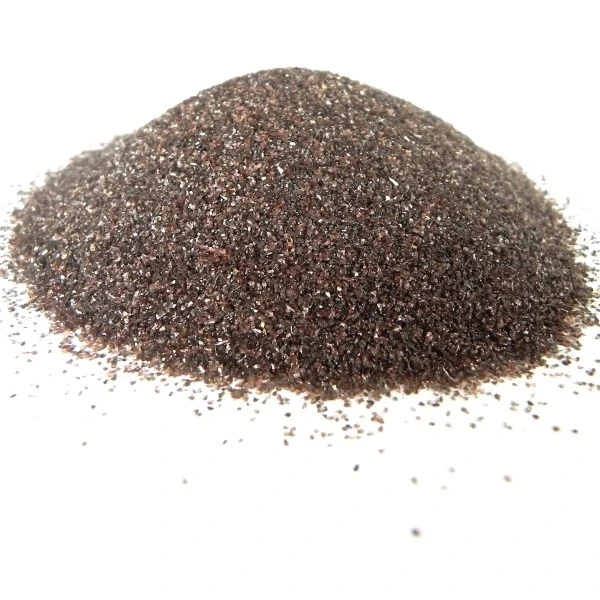
3. Why Grain Shape and Bulk Density Matter
Two F36 abrasives can have similar chemical compositions but different grain shapes.
One may contain more elongated or flaky particles, while another may have a more compact particle structure.
These differences influence packing, mixing and pressing.
Grain shape affects how particles arrange within the resin bond.
Bulk density describes how much loose abrasive occupies a given volume, including spaces between particles.
Higher bulk density can be useful for certain manufacturing requirements, but it does not automatically mean better cutting performance.
Hengye uses grain-shaping equipment for applicable brown fused alumina grades to help control particle morphology.
Buyers should compare actual bulk density results and conduct finished-wheel testing before changing materials.
4. How to Evaluate Brown Fused Alumina Quality
A useful supplier evaluation should include chemical composition, grading, physical properties and production consistency.
|
Parameter |
What Buyers Should Check |
|---|---|
|
Al₂O₃ |
Required minimum content |
|
Fe₂O₃ |
Maximum acceptable impurity |
|
Grit Size |
FEPA or agreed grading standard |
|
Grain Shape |
Morphology suitable for the bond |
|
Bulk Density |
Measured value and test method |
|
Particle Distribution |
Oversize and fine fractions |
|
Toughness |
Performance in actual cutting trials |
|
Batch Consistency |
Results across production lots |
For many conventional brown fused alumina grades, Al₂O₃ content is around 95%, but the actual specification must be confirmed for the material being purchased.
A Certificate of Analysis is useful, but chemical composition alone cannot predict cutting disc performance.
5. How to Calculate the Real Abrasive Cost
The cheapest abrasive per ton may not produce the cheapest cutting disc.
Consider the following example.
|
Metric |
Abrasive A |
Abrasive B |
|---|---|---|
|
Abrasive Price |
$900/MT |
$1,050/MT |
|
Abrasive Used per Disc |
80 g |
80 g |
|
Abrasive Cost per Disc |
$0.072 |
$0.084 |
|
Average Cuts per Disc |
20 |
26 |
|
Abrasive Cost per Cut |
$0.0036 |
$0.0032 |
Illustrative figures only, not actual Hengye test results or quotations.
Although Abrasive B costs more per ton, its abrasive cost per cut is lower in this example.
This calculation excludes resin, reinforcement, labor and other costs, but it demonstrates why buyers should evaluate cutting performance alongside purchase price.
6. How to Test a New Abrasive Supplier
Before placing a bulk order, conduct a controlled trial.
Keep the following conditions consistent:
Cutting disc formulation
Wheel dimensions
Workpiece material
Machine operating conditions
Test procedure
Measure cutting time, number of cuts, wheel wear and finished-disc consistency.
A useful supplier should also be able to discuss grain size, shaping, bulk density and inspection procedures.
Hengye supplies brown fused alumina for industrial abrasive manufacturing and can discuss F36 specifications with cutting disc producers.


Frequently Asked Questions
Is F36 brown fused alumina suitable for resin cutting discs?
Yes. F36 is commonly considered for resin cutting disc formulations, although suitability depends on the complete wheel design.
Does higher Al₂O₃ content guarantee better cutting?
No. Chemical composition is important, but grain toughness, morphology and bond compatibility also influence cutting performance.
Can grain shaping improve cutting disc production?
Grain shaping can influence particle packing and consistency. The actual benefit should be verified through production testing.
Why do two F36 abrasives have different prices?
Differences in raw materials, processing, grain shaping, inspection and commercial terms can affect quotations.
Should manufacturers request samples before bulk purchasing?
Yes. Representative sample testing is particularly valuable when changing suppliers.
Request Brown Fused Alumina F36 from Hengye
Looking for a brown fused alumina manufacturer for resin cutting disc production?
Hengye supplies processed brown fused alumina and supports specification-based purchasing discussions.
Send your required grit, bulk density target, current specification and monthly consumption to request product information, sample arrangements and a factory quotation.


