

Two suppliers can offer brown fused alumina with the same grit size, similar Al₂O₃ content, and competitive prices-yet their materials may behave differently during grinding wheel production.
Why?
Because abrasive quality is determined by more than chemical composition. Grain shape, particle size distribution, bulk density, impurity control, and consistency between production batches can all influence manufacturing results.
For grinding wheel manufacturers, an inconsistent abrasive may require formulation adjustments, cause unexpected processing variation, or affect finished-wheel performance.
The best way to evaluate brown fused alumina quality is to combine laboratory inspection with controlled production trials and repeat-batch verification.
This guide explains nine practical quality checks, how to interpret supplier test reports, and how to qualify a brown fused alumina manufacturer before committing to a bulk order.


What Determines Brown Fused Alumina Quality?
Brown fused alumina (BFA), also known as brown corundum or brown aluminum oxide, is a synthetic abrasive produced by melting bauxite-based raw materials in an electric arc furnace.
Its primary component is aluminum oxide (Al₂O₃), with smaller amounts of other oxides and elements.
Brown fused alumina is widely used in resin-bonded grinding wheels, cutting discs, vitrified grinding wheels, coated abrasives, and industrial surface preparation.
However, the quality requirements differ by application.
For example, a resin cutting disc manufacturer may prioritize grain toughness, shape, and bulk density, while a precision grinding wheel manufacturer may place greater emphasis on grading consistency and controlled grain fracture.
|
Quality Dimension |
Main Parameters |
Why It Matters |
|---|---|---|
|
Chemical Quality |
Al₂O₃, Fe₂O₃, SiO₂, TiO₂ |
Confirms material composition |
|
Physical Quality |
Grain shape, bulk density, true density |
Influences packing and processing |
|
Grading Quality |
Particle size distribution, oversize, fines |
Supports consistent wheel formulation |
|
Functional Quality |
Toughness, fracture behavior, grinding performance |
Determines suitability for the application |
|
Supply Consistency |
Lot variation, traceability, inspection records |
Supports repeatable mass production |
An important distinction is that a material can pass a chemical specification and still fail in the customer's grinding wheel formulation.
That is why supplier qualification should involve both laboratory testing and application testing.
Nine Essential Brown Fused Alumina Quality Checks
Al₂O₃ content is one of the first specifications buyers examine.
Many conventional first-grade brown fused alumina products contain approximately 95% Al₂O₃, although exact requirements vary by grade and application.
Higher Al₂O₃ content may indicate a different composition, but it does not automatically mean the abrasive will cut faster or produce a longer-lasting grinding wheel.
The actual performance depends on grain structure, toughness, fracture behavior, and the bond system.
What should buyers request?
Ask the supplier for a chemical analysis report that identifies the tested batch and measurement method.
Compare the results with your agreed purchasing specification rather than assuming that one universal Al₂O₃ value suits every application.
Iron-related impurities deserve attention, particularly in abrasive applications with strict cleanliness or processing requirements.
Fe₂O₃ reported in a chemical analysis is not identical to the amount of removable magnetic material in a finished abrasive.
These are different measurements.
A supplier may use magnetic separation to reduce ferromagnetic contaminants, but the effectiveness should be evaluated against the agreed specification and test procedure.
For manufacturers, the key questions are:
Is the chemical iron-related specification satisfied?
Is a separate magnetic material limit required?
What test method is used?
Are results consistent between batches?
Hengye uses magnetic separation in relevant brown fused alumina processing operations to help control unwanted magnetic contaminants.
Two products labeled F36 are not necessarily identical in their particle size distributions.
A nominal grit designation refers to a defined grading system, but the complete distribution must be considered.
Excessive coarse particles or fines can influence abrasive packing and the behavior of the finished wheel.
Buyers should specify the applicable FEPA standard or another agreed grading standard.
A particle size report should identify the test procedure and the distribution results.
Do not compare FEPA F-grit, FEPA P-grit, and other grading systems as if their numbers were interchangeable.
For grinding wheel manufacturing, using a consistent grading standard is essential.
Grain shape is often overlooked when buyers compare brown fused alumina quotations.
Crushing operations can produce particles with different morphologies, including relatively equant, elongated, or flaky grains.
These differences can influence how abrasive particles pack, flow, and interact with the bond.
More equant grains may be useful in formulations requiring controlled packing behavior, while sharper or more elongated particles may be appropriate for other applications.
There is no universally superior grain shape.
The correct morphology depends on the intended abrasive tool.
Hengye uses Barmac grain-shaping equipment for applicable brown fused alumina grades to help control particle shape.
When comparing suppliers, request grain images or representative samples and verify performance in the actual wheel formulation.
Bulk density is the mass of loose abrasive divided by the volume it occupies, including the spaces between particles.
It is commonly expressed in g/cm³.
The formula is:
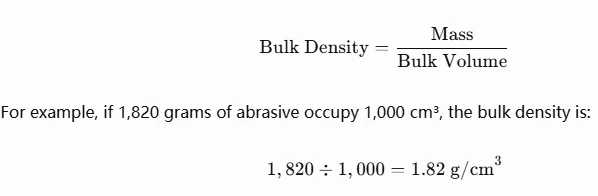
This is a calculation example, not a guaranteed value for Hengye F36.
Bulk density can be influenced by grain shape, particle size distribution, and the measurement method.
For grinding wheel manufacturers, bulk density is especially useful as a consistency indicator.
However, higher bulk density does not necessarily produce a better grinding wheel.
It must be evaluated alongside grain morphology, grading, and finished-wheel performance.
Brown fused alumina is valued for its combination of hardness and toughness.
But toughness must be appropriate for the application.
If abrasive grains fracture too easily, the finished wheel may wear rapidly under certain operating conditions.
If grains resist fracture excessively, they may become dull instead of exposing effective cutting edges.
The desired balance depends on grinding pressure, bond characteristics, workpiece material, and operating conditions.
Buyers should ask whether the supplier has relevant toughness or friability test information.
Where laboratory measurements are unavailable or do not correlate well with the intended use, controlled grinding trials are particularly important.
Excessive fine dust may create problems during abrasive handling and mixing.
For certain resin-bonded abrasive formulations, unwanted fine material can affect processing consistency.
Dust may come from crushing, grading, transportation, or handling.
Suitable screening and dry-washing processes can help control fine material in the finished abrasive.
Hengye uses precision screening and dry-washing processes for applicable brown fused alumina products.
Buyers should still evaluate the supplied material using their own cleanliness and particle distribution requirements.
Moisture can influence powder handling and may create difficulties in certain manufacturing processes.
For resin-bonded products, moisture control should be consistent with the formulation and storage conditions.
Buyers should confirm packaging integrity and storage recommendations.
When moisture is a critical parameter, include a defined test method and acceptance limit in the purchasing specification.
Packaging should protect the material during transport and storage.
One excellent sample does not guarantee a reliable long-term supply.
For industrial buyers, consistency is often more valuable than an isolated high test result.
A supplier should be able to demonstrate how it controls product specifications across production lots.
This includes raw material management, processing controls, inspection procedures, and batch identification.
A useful qualification process compares multiple lots instead of relying on one sample.
How Manufacturing Processes Influence Brown Fused Alumina Quality
Understanding the production process helps buyers identify where quality differences may arise.
Brown fused alumina begins with bauxite-based raw materials.
Variations in raw material composition can influence the final abrasive chemistry and crystal characteristics.
A manufacturer should have procedures for selecting and inspecting incoming materials.
The raw materials are melted at high temperatures to form fused alumina.
Furnace conditions and process control influence the resulting material.
For Hengye's relevant brown fused alumina production, high-temperature smelting typically takes approximately six hours.
The objective is to produce suitable fused alumina crystals while controlling the process conditions.
However, smelting duration alone is not proof of superior abrasive quality.
The finished product must still be inspected.
After cooling, fused alumina is crushed into smaller particles.
Crushing methods influence particle morphology.
Additional grain shaping can help modify the proportion of elongated or flaky particles.
Hengye uses crushing equipment, double-roller processing, and Barmac shaping for relevant brown fused alumina products.
Magnetic separation is used to help remove certain magnetic contaminants from processed abrasive material.
Its effectiveness depends on the material and processing conditions.
Screening separates abrasive particles into specified grit sizes.
Accurate grading helps maintain particle size consistency.
Dry-washing and dust-removal processes can reduce unwanted fines.
Finished abrasive should then be checked against the applicable chemical and physical specifications.
|
Production Stage |
Quality Objective |
What Buyers Should Verify |
|---|---|---|
|
Raw Material Selection |
Control Starting Composition |
Chemical Analysis |
|
Smelting |
Produce Suitable Fused Alumina |
Finished Material Properties |
|
Crushing |
Produce Required Grain Sizes |
Particle Distribution |
|
Grain Shaping |
Control Particle Morphology |
Grain Images, Bulk Density |
|
Magnetic Separation |
Reduce Certain Contaminants |
Relevant Impurity Tests |
|
Screening |
Maintain Grading Consistency |
Sieve Analysis |
|
Dust Removal |
Control Unwanted Fines |
Fine Content and Cleanliness |
|
Final Inspection |
Verify Specifications |
Batch Test Report |
The important lesson is that manufacturing equipment matters only when it produces measurable results that meet the buyer's requirements.
How to Read a Brown Fused Alumina Certificate of Analysis
A Certificate of Analysis (COA) is an important document, but buyers should understand what it proves-and what it does not.
A COA normally reports the results of specified tests on an identified material or batch.
It does not automatically demonstrate the performance of the abrasive in a finished grinding wheel.
The following table illustrates how a buyer might evaluate an F36 brown fused alumina shipment.
|
Parameter |
Example Purchasing Requirement |
Example Supplier Result |
Evaluation |
|---|---|---|---|
|
Al₂O₃ |
≥95.0% |
95.4% |
Pass |
|
Fe₂O₃ |
≤0.20% |
0.15% |
Pass |
|
SiO₂ |
≤1.00% |
0.75% |
Pass |
|
Grit Size |
F36, Agreed FEPA Standard |
Report Attached |
Review Distribution |
|
Bulk Density |
1.78–1.88 g/cm³ |
1.83 g/cm³ |
Pass |
|
Grain Shape |
Approved Reference Sample |
Visual Report |
Compare with Reference |
|
Moisture |
Agreed Limit |
Test Required |
Pending |
All requirements and results in this table are hypothetical examples. They are not actual Hengye batch specifications, certificates, or test results.
Notice that a supplier cannot be fully approved merely because the first three chemical values pass.
Particle size distribution, physical characteristics, and application performance may still require verification.
First, does the report identify the production batch?
Second, are the results actual measurements or simply catalog specifications?
Third, are the test methods clearly stated?
Fourth, do the results correspond to the material being shipped?
Finally, does the report include the parameters that matter to your manufacturing process?
A well-prepared COA supports purchasing decisions, but it should be used together with sample evaluation and supplier qualification.

How to Conduct a Brown Fused Alumina Supplier Sample Test
For grinding wheel manufacturers, laboratory results should be followed by a controlled production trial.
A practical qualification process can be divided into four stages.
Before testing a new abrasive supplier, record the performance of your existing approved material.
This becomes the reference against which the new material is evaluated.
Useful baseline data may include:
Abrasive consumption per production batch
Mixing and pressing behavior
Finished-wheel rejection rate
Grinding or cutting performance
Wheel wear
Surface finish
Manufacturing cost
Without a baseline, it is difficult to determine whether a new material represents an improvement.
Test the new sample against the existing material using the same procedures.
|
Test Item |
Existing Abrasive |
New Abrasive |
Decision |
|---|---|---|---|
|
Chemical Composition |
Record Result |
Record Result |
Within Specification? |
|
Grit Distribution |
Record Result |
Record Result |
Comparable? |
|
Bulk Density |
Record Result |
Record Result |
Within Target Range? |
|
Grain Shape |
Reference Images |
Sample Images |
Acceptable? |
|
Fine Content |
Record Result |
Record Result |
Acceptable? |
|
Packaging Condition |
Record |
Record |
Acceptable? |
A difference does not automatically mean the new abrasive is unsuitable.
It means the difference should be evaluated against the intended application.
Produce trial wheels using a controlled process.
Where possible, keep the following factors unchanged:
Resin or vitrified bond formulation
Abrasive loading
Wheel dimensions
Mixing procedure
Pressing conditions
Curing or firing conditions
Reinforcement and other ingredients
Changing several variables at once makes it difficult to identify the cause of performance differences.
If the new abrasive requires formulation adjustments, conduct a separate optimization trial after the initial comparison.
The final test should reflect the actual customer application.
For resin cutting discs, measure cutting time, wheel wear, and the number of acceptable cuts.
For grinding wheels, useful measurements may include material removal rate, wheel wear, grinding ratio, and workpiece surface condition.
The grinding ratio, or G-ratio, is commonly expressed as:

A higher G-ratio indicates more material removed per unit of wheel wear, but it should not be considered independently of cutting efficiency, surface quality, and operating conditions.
Suppose a manufacturer tests two F36 brown fused alumina materials under identical cutting conditions.
|
Test Metric |
Existing Supplier |
Trial Supplier |
|---|---|---|
|
Average Cutting Time |
18 seconds |
17 seconds |
|
Average Cuts per Disc |
22 |
25 |
|
Abrasive Cost per Disc |
$0.080 |
$0.086 |
|
Abrasive Cost per Cut |
$0.00364 |
$0.00344 |
Hypothetical figures for illustrating the evaluation method only.
In this example, the trial supplier has a higher abrasive cost per disc but a lower abrasive cost per cut.
That may justify further investigation.
However, the manufacturer must still confirm that the results are repeatable and that both discs meet applicable quality and safety requirements.
A single trial is not enough to approve a permanent supplier change.
How to Measure Batch-to-Batch Consistency
A common purchasing mistake is approving a supplier based on one excellent sample and then assuming every future shipment will perform identically.
Industrial production requires a more systematic approach.
Where practical, request samples representing multiple normal production lots.
Compare their chemical and physical properties.
The objective is not to eliminate all variation. Every manufacturing process has some variation.
The objective is to confirm that the variation remains within agreed limits and does not disrupt the customer's manufacturing process.
Consider three hypothetical bulk density results from separate F36 production lots:
|
Production Lot |
Bulk Density |
|---|---|
|
Lot A |
1.81 g/cm³ |
|
Lot B |
1.84 g/cm³ |
|
Lot C |
1.82 g/cm³ |
|
Average |
1.823 g/cm³ |
|
Range |
0.03 g/cm³ |
These values demonstrate how a buyer can summarize variation.
They do not establish whether the process is statistically capable or whether the material is acceptable.
That requires an appropriate sample size, measurement system, specification limits, and ongoing production data.
Once a supplier is approved, define which characteristics must be inspected for each shipment.
For example, chemical composition and particle size may require routine verification.
Bulk density or grain morphology may also be important for specific formulations.
Inspection frequency should reflect the material's risk, supplier performance, and the buyer's quality-management requirements.
Each shipment should be identifiable by lot or batch.
Traceability helps manufacturers investigate production problems and distinguish material-related issues from changes elsewhere in the process.
For large-volume buyers, traceability can be just as important as the initial test results.
How Much Can Poor Abrasive Quality Cost a Grinding Wheel Factory?
Abrasive purchasing decisions should account for the cost of nonconforming material.
A lower raw material price may be offset by additional inspection, production downtime, rejected wheels, or customer complaints.
Consider a hypothetical grinding wheel factory producing 100,000 wheels per month.
|
Cost Item |
Supplier A |
Supplier B |
|---|---|---|
|
Abrasive Cost per Wheel |
$0.080 |
$0.085 |
|
Monthly Abrasive Cost |
$8,000 |
$8,500 |
|
Finished-Wheel Rejection Rate |
3.0% |
1.5% |
|
Rejected Wheels |
3,000 |
1,500 |
|
Assumed Loss per Rejected Wheel |
$0.50 |
$0.50 |
|
Rejection Loss |
$1,500 |
$750 |
|
Combined Abrasive + Rejection Cost |
$9,500 |
$9,250 |
This is an illustrative scenario, not a real customer case. It assumes that the rejection-rate difference is attributable to the abrasive and that the stated loss per rejected wheel is applicable.
Under these assumptions, Supplier B produces a lower combined cost despite charging more for the abrasive.
The example also shows why buyers should investigate the causes of rejection before attributing them to raw material quality.
The correct decision should consider the complete production process.
For a simplified comparison:
\[ \text{Evaluated Cost}=\text{Material Cost}+\text{Quality Losses}+\text{Additional Processing Costs} \]
A more complete model can also include freight, inventory, downtime, inspection, and warranty costs.
This is why experienced buyers evaluate total cost of ownership, not simply price per metric ton.
How to Evaluate a Brown Fused Alumina Manufacturer in China
Selecting a reliable brown fused alumina manufacturer requires more than checking a company profile or requesting the lowest quotation.
A factory should be evaluated against the specific requirements of your manufacturing process.
Ask which manufacturing stages the supplier controls.
For brown fused alumina, these may include smelting, crushing, shaping, magnetic separation, screening, and final inspection.
A supplier should explain how these processes influence the specifications it can offer.
A capable abrasive supplier should ask about your intended application.
For example, a cutting disc manufacturer may need to discuss grain toughness, shape, and bulk density.
A vitrified grinding wheel manufacturer may need to discuss particle size distribution and formulation compatibility.
A supplier that understands these differences can support more useful technical discussions.
Depending on the application, request:
- Certificate of Analysis
- Particle size distribution report
- Relevant physical property results
- Safety Data Sheet
- Product specification
- Batch identification information
Do not assume that every document is available for every product. Confirm the requirements before placing an order.
For regular bulk purchasing, buyers should confirm packaging, minimum order quantity, lead time, and applicable shipping terms.
Also establish how specification changes and quality complaints will be handled.
The lowest quotation may be unattractive if the supplier cannot maintain the required material consistency.
Why Consider Hengye for Brown Fused Alumina Supply?
Hengye supplies brown fused alumina and white fused alumina for industrial abrasive applications.
For applicable brown fused alumina grades, our manufacturing and processing capabilities include high-temperature smelting, crushing, double-roller processing, Barmac grain shaping, magnetic separation, precision screening, and dust removal.
These processes support the production of abrasive materials with controlled chemical and physical characteristics.
Hengye also performs relevant quality inspections, including bulk density testing, particle size analysis, and elemental analysis.
For grinding wheel manufacturers, we understand that the most important question is not simply whether an abrasive meets a catalog specification.
It is whether the material can meet the customer's actual manufacturing requirements consistently.
For an efficient technical discussion, provide the following details.
|
Required Information |
Example |
|---|---|
|
Product |
Brown Fused Alumina |
|
Application |
Resin Cutting Disc |
|
Grit Size |
F36 |
|
Chemical Requirement |
Al₂O₃ ≥95% |
|
Bulk Density |
Customer-Specified Range |
|
Grain Shape |
Shaped or Standard |
|
Monthly Quantity |
20 MT |
|
Packaging |
25 kg Bags or Big Bags |
|
Destination |
Country or Port |
|
Sample Requirement |
Yes |
The specifications above are examples of information buyers may provide, not a universal Hengye product specification.
Providing a clear purchasing specification helps avoid misunderstandings and makes quotations easier to compare.


