

A cutting disc that lasts longer is not necessarily a cutting disc that performs better.
For resin cutting disc manufacturers, the ideal abrasive must balance cutting speed, wheel wear, self-sharpening ability, manufacturing consistency, and operating costs.
Brown fused alumina grain toughness plays an important role in achieving this balance.
If abrasive grains fracture too easily, the cutting disc may wear prematurely. If the grains resist fracture excessively, their cutting edges may become dull, increasing grinding resistance and reducing cutting efficiency.
The best brown fused alumina is not necessarily the toughest grade available. It is the grade with fracture characteristics that match the cutting disc formulation and intended application.
Understanding this relationship can help manufacturers improve product development, troubleshoot production problems, evaluate abrasive suppliers, and make more economical purchasing decisions.
This guide explains how grain toughness works, what determines it, how it influences cutting disc performance, and how industrial buyers can evaluate brown fused alumina before placing a bulk order.
1. What Is Brown Fused Alumina Grain Toughness?
Brown fused alumina grain toughness describes the resistance of individual abrasive grains to fracture when subjected to mechanical forces.
Brown fused alumina, also known as brown corundum or brown aluminum oxide, is manufactured by melting bauxite-based raw materials in an electric arc furnace.
Its main component is aluminum oxide (Al₂O₃), with smaller amounts of titanium oxide, silicon oxide, iron-related compounds, and other constituents.
Conventional brown fused alumina generally contains approximately 95% Al₂O₃ and has a Mohs hardness of around 9.
However, chemical composition and hardness alone cannot explain how an abrasive behaves during cutting.
When a resin cutting disc contacts a steel workpiece, individual abrasive grains experience repeated mechanical loading, friction, and thermal effects.
Under these conditions, a grain may remain intact, develop wear flats, fracture partially, break into smaller fragments, or become detached from the bond.
These mechanisms influence the cutting behavior of the finished disc.
Why Grain Toughness Matters to Cutting Disc Manufacturers
A cutting disc contains many abrasive grains distributed throughout a bonded structure.
Each exposed grain contributes to material removal.
If the grains maintain effective cutting edges for an appropriate period, the disc can continue removing material efficiently.
If the grains fracture or detach prematurely, abrasive material may be consumed without contributing sufficient cutting work.
Conversely, if the grains become dull without fracturing or being released at the appropriate time, cutting resistance may increase.
The objective is to achieve controlled abrasive wear rather than simply maximum grain strength.
2. Hardness vs Toughness vs Friability: What Is the Difference?
Hardness, toughness, and friability are frequently used when describing industrial abrasives.
However, they represent different material characteristics.
|
Property |
Definition |
Relevance to Cutting Discs |
|---|---|---|
|
Hardness |
Resistance to scratching or indentation |
Ability to penetrate and remove workpiece material |
|
Toughness |
Resistance to fracture under mechanical loading |
Ability to withstand cutting forces |
|
Friability |
Tendency to fracture under applied stress |
Ability to expose new cutting edges |
|
Wear Resistance |
Resistance to material loss during use |
Influences abrasive consumption |
|
Self-Sharpening |
Renewal of effective cutting edges through controlled wear or fracture |
Helps maintain cutting efficiency |
A hard abrasive is not necessarily a tough abrasive.
For example, silicon carbide is generally harder than conventional brown fused alumina, but it is also more brittle.
White fused alumina is commonly more friable than brown fused alumina, although both materials have high hardness.
Comparison of Common Industrial Abrasives
|
Property |
Brown Fused Alumina |
White Fused Alumina |
Green Silicon Carbide |
|---|---|---|---|
|
Main Component |
Al₂O₃ |
Al₂O₃ |
SiC |
|
Mohs Hardness |
Approx. 9 |
Approx. 9 |
Approx. 9–9.5 |
|
Relative Toughness |
Generally Higher |
Generally Lower than BFA |
Generally More Brittle |
|
Fracture Behavior |
Relatively Resistant to Fracture |
More Friable |
Sharp, Brittle Fracture |
|
Common Applications |
Cutting Discs, General Grinding |
Precision Grinding, Vitrified Wheels |
Glass, Ceramics, Carbides |
|
Main Selection Consideration |
Balance of Strength and Cutting Action |
Controlled Grain Fracture |
Hardness and Sharpness |
These are general material comparisons. Actual toughness and fracture characteristics vary according to grade, manufacturing conditions, and grain processing.
For cutting disc manufacturers, understanding these differences is more useful than comparing Mohs hardness values alone.
3. What Determines the Toughness of Brown Fused Alumina?
Brown fused alumina toughness is influenced by several interconnected factors.
The finished abrasive grain inherits characteristics from its raw materials, smelting process, crystal structure, cooling conditions, and subsequent mechanical processing.
Raw Material Composition
Brown fused alumina is primarily manufactured from bauxite.
The composition of the raw material influences the chemical characteristics of the resulting fused alumina.
Al₂O₃ is the principal component, while titanium-containing compounds and other constituents can influence crystal characteristics and mechanical behavior.
However, buyers should not assume that increasing or decreasing a single oxide percentage will automatically improve grain toughness.
The relationship between chemistry and mechanical performance depends on the phases present, their distribution, and the manufacturing process.
Titanium Oxide Content
Titanium-related constituents are one of the characteristics commonly examined when comparing brown fused alumina grades.
They can influence the properties of the fused abrasive and are relevant when evaluating differences between conventional brown fused alumina and other aluminum oxide abrasives.
A chemical analysis report may express titanium content as TiO₂.
However, this reported value does not fully describe the chemical state or distribution of titanium within the abrasive crystals.
Two products with similar reported TiO₂ content may still exhibit different fracture behavior.
For this reason, titanium content should be considered together with physical testing and application performance.
Electric Arc Furnace Smelting
During electric arc furnace smelting, raw materials are melted to produce fused alumina.
The furnace conditions influence material formation and the resulting crystal characteristics.
Relevant production variables include energy input, raw material composition, melting conditions, and process duration.
At Hengye, the smelting process for relevant brown fused alumina products typically takes approximately six hours in large electric arc furnaces.
The purpose of controlled smelting is to establish suitable fused material characteristics before crushing and classification.
A longer smelting period alone does not guarantee superior toughness. The finished abrasive must still be evaluated through chemical, physical, and functional inspection.
Crystal Structure and Cooling Conditions
After smelting, fused alumina must cool and solidify.
Solidification conditions can influence crystal dimensions, phase distribution, internal stresses, and other structural characteristics.
Internal defects and microcracks may affect how individual abrasive grains respond to mechanical loading.
This helps explain why products with similar chemical compositions can exhibit different fracture behavior.
For industrial buyers, chemical analysis is therefore necessary but insufficient for predicting grain performance.
Crushing and Grain Shaping
After solidification, fused alumina blocks are crushed into smaller abrasive grains.
Mechanical processing can influence grain morphology and introduce or expose structural defects.
Different crushing methods may produce different proportions of compact, angular, elongated, or flaky particles.
Grain shaping can further modify particle morphology.
For applicable brown fused alumina grades, Hengye uses double-roller processing and Barmac grain-shaping equipment to help reduce undesirable elongated and flaky particles.
The objective is to achieve controlled grain morphology and physical characteristics suitable for the customer's manufacturing requirements.
Factors Influencing Brown Fused Alumina Toughness
|
Manufacturing Factor |
Potential Influence |
Buyer Evaluation Method |
|---|---|---|
|
Bauxite Quality |
Starting Material Composition |
Chemical Analysis |
|
Titanium-Related Constituents |
Crystal and Phase Characteristics |
Elemental Analysis and Functional Testing |
|
Smelting Conditions |
Fused Material Formation |
Production Review |
|
Cooling Conditions |
Crystal Structure and Internal Defects |
Material Characterization |
|
Crushing Method |
Particle Shape and Fracture Characteristics |
Grain Inspection |
|
Grain Shaping |
Particle Morphology and Packing |
Bulk Density and Imaging |
|
Final Classification |
Consistency of Tested Grain Sizes |
Particle Size Analysis |
The most useful supplier evaluation combines manufacturing information with measurable finished-material properties.
4. How Does Grain Toughness Affect Cutting Disc Performance?
The relationship between abrasive grain toughness and cutting performance can be understood through the life cycle of an individual abrasive grain.
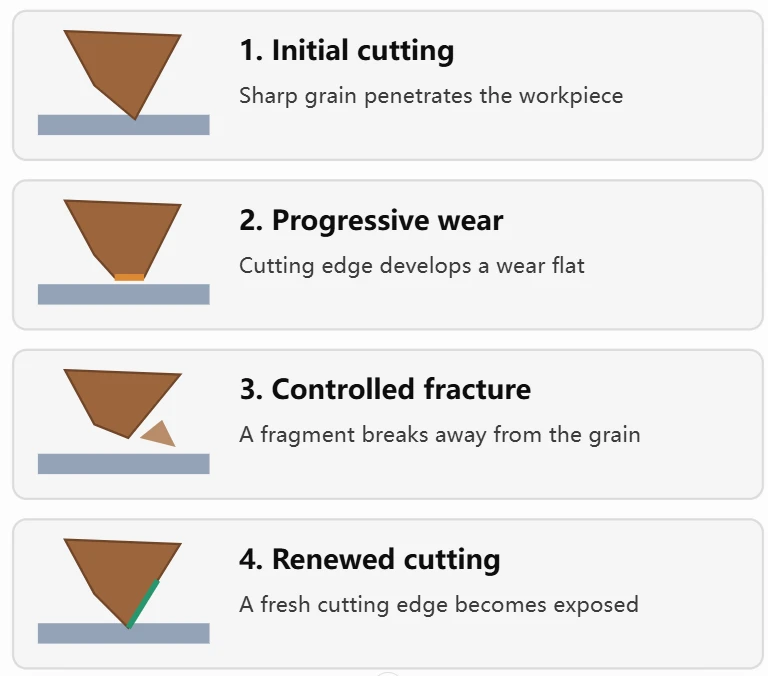
Conceptual illustration of abrasive grain wear and controlled fracture. Actual grain behavior depends on the abrasive, bond and cutting conditions.
Cutting Speed
Effective cutting requires abrasive grains to penetrate the workpiece and remove material.
Sharp cutting edges generally support efficient material removal.
When grains develop excessive wear flats, the interaction may shift toward rubbing and plowing rather than effective cutting.
This can increase cutting resistance.
Abrasive grains with suitable fracture characteristics may expose new cutting edges as mechanical loading increases.
However, excessive grain fracture can also reduce efficiency by consuming abrasive material prematurely.
Cutting speed therefore depends on a balance between grain strength and edge renewal.
Cutting Disc Service Life
Cutting disc service life is influenced by the rate at which abrasive grains and bond materials are consumed.
If grains fracture excessively under normal operating conditions, wheel wear may increase.
If the grains remain effective for longer without excessive dulling, abrasive utilization may improve.
However, disc service life is not determined by grain toughness alone.
Bond strength, abrasive concentration, wheel dimensions, reinforcement, operating conditions, and workpiece characteristics also contribute.
A long-lasting disc that cuts slowly may be less economical than a disc with moderately shorter life and significantly faster cutting.
Self-Sharpening Ability
Self-sharpening describes the renewal of effective abrasive cutting edges through controlled grain fracture, wear, or grain release.
Abrasive grains do not remain sharp indefinitely.
As cutting progresses, their exposed edges can become rounded or flattened.
Controlled fracture can expose new edges and help maintain material removal.
This mechanism is particularly important when selecting abrasives for different cutting conditions.
The challenge is to ensure that grain renewal occurs at a useful rate.
Too much fracture may increase wheel consumption. Too little fracture may allow excessive dulling.
Cutting Temperature
When abrasive grains become dull, more energy may be consumed through friction and deformation rather than effective material removal.
This can contribute to increased cutting temperatures.
Potential consequences may include workpiece discoloration, changes in surface condition, and reduced cutting efficiency.
However, elevated temperature can also result from inappropriate operating parameters, unsuitable bond characteristics, or other factors.
Grain toughness should be investigated as one possible contributor rather than treated as the sole cause.
Cutting Stability
Consistency between abrasive grains and production batches helps manufacturers maintain predictable cutting disc behavior.
If grain fracture characteristics vary significantly between batches, the finished wheels may exhibit different wear or cutting behavior.
This is particularly important for manufacturers supplying standardized cutting discs to industrial distributors and professional users.
A stable abrasive specification supports more repeatable product development and quality control.
5. Can Brown Fused Alumina Be Too Tough?
Yes. Excessive grain toughness relative to the intended cutting conditions can be undesirable.
A common misconception among abrasive buyers is that tougher grains always produce better cutting discs.
In reality, the relationship is more complex.
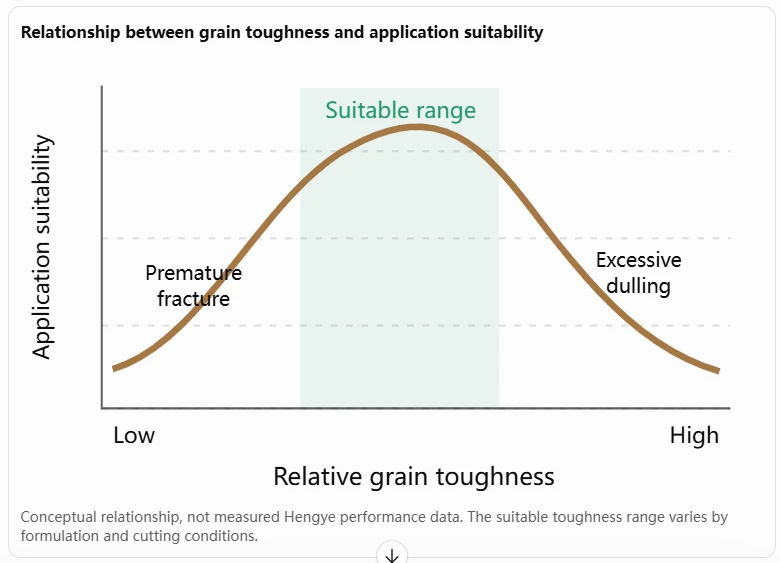
When Grain Toughness Is Too Low
Abrasive grains may fracture before completing sufficient cutting work.
Possible effects include increased wheel wear, greater abrasive consumption, shorter disc life, and reduced dimensional stability during use.
When Grain Toughness Is Too High
Grains may resist fracture even after their cutting edges have become dull.
Possible effects include increased cutting resistance, longer cutting time, increased frictional heating, and inefficient abrasive utilization.
When Grain Toughness Matches the Application
The abrasive grains can withstand the expected mechanical loading while maintaining effective cutting action through appropriate wear and fracture behavior.
|
Grain Behavior |
Insufficient Toughness |
Suitable Toughness |
Excessive Toughness |
|---|---|---|---|
|
Fracture Resistance |
Too Low |
Application-Appropriate |
Potentially Too High |
|
Edge Renewal |
Excessive Fracture |
Controlled |
Potentially Insufficient |
|
Wheel Wear |
May Increase |
Balanced |
Depends on Bond Behavior |
|
Cutting Resistance |
Variable |
Controlled |
May Increase |
|
Abrasive Utilization |
Potentially Poor |
More Effective |
Potentially Poor |
The optimum balance changes with the cutting disc formulation.
This is why abrasive suppliers should understand the customer's application before recommending a particular brown fused alumina grade.
6. Why Can Two F36 Brown Fused Alumina Products Perform Differently?
F36 is a grit designation, not a complete performance specification.
Two brown fused alumina manufacturers may supply products with the same nominal F36 size and similar Al₂O₃ content.
Nevertheless, their abrasive grains may differ in several important respects.
Example Comparison of Two F36 Materials
|
Parameter |
Abrasive A |
Abrasive B |
|---|---|---|
|
Nominal Grit Size |
F36 |
F36 |
|
Al₂O₃ Content |
95.2% |
95.3% |
|
Grain Morphology |
Mixed Angular and Elongated |
More Equant |
|
Bulk Density |
1.72 g/cm³ |
1.86 g/cm³ |
|
Fracture Characteristics |
Requires Testing |
Requires Testing |
|
Particle Size Distribution |
Within Agreed Limits |
Within Agreed Limits |
Illustrative specifications only. These are not actual Hengye batch results.
Despite their similar chemical compositions, the two abrasives may exhibit different packing behavior during cutting disc production.
Their fracture behavior may also differ because of crystal characteristics and processing history.
Grain Shape Is Not the Same as Grain Toughness
A more compact abrasive grain may have different packing and mechanical loading characteristics than an elongated grain.
However, grain shape alone does not establish intrinsic material toughness.
Similarly, higher bulk density does not prove higher grain toughness.
Bulk density is influenced by particle morphology, size distribution, and packing.
For manufacturers evaluating F36 brown fused alumina, these characteristics should be measured separately.
The correct question is not simply:
"Which F36 abrasive has the highest bulk density?"
It is:
"Which F36 abrasive produces the most suitable and repeatable cutting disc performance in our formulation?"
7. How to Evaluate Brown Fused Alumina Grain Toughness
A reliable evaluation should include both abrasive-level testing and finished-disc performance testing.
Abrasive Grain Fracture Testing
One approach is to expose a controlled abrasive sample to a defined mechanical loading or impact procedure.
The particle size distribution before and after testing can then be compared.
The degree of grain breakdown provides information about resistance to fracture under the selected test conditions.
Some manufacturers and laboratories use ball-milling or other controlled mechanical methods to evaluate abrasive grain fracture behavior.
However, results from different test procedures should not be compared directly without understanding their measurement conditions.
Calculate Grain Retention
A simplified grain-retention calculation may be expressed as:

For example:
|
Test Parameter |
Sample A |
Sample B |
|---|---|---|
|
Initial Sample Mass |
100 g |
100 g |
|
Retained Mass Above Defined Sieve |
72 g |
85 g |
|
Illustrative Retention |
72% |
85% |
Under the assumed identical test conditions, Sample B exhibits greater retention above the selected sieve opening.
This suggests greater resistance to breakdown according to that particular test.
It does not establish a universal toughness value or prove that Sample B will produce a better cutting disc.
Control the Testing Variables
For meaningful comparisons, the following factors should remain consistent.
|
Testing Variable |
Reason for Control |
|---|---|
|
Initial Grit Distribution |
Different Grain Sizes Can Fracture Differently |
|
Sample Mass |
Supports Comparable Mechanical Loading |
|
Test Equipment |
Different Equipment May Produce Different Results |
|
Mechanical Loading |
Influences Grain Breakdown |
|
Test Duration |
Affects the Degree of Fracture |
|
Evaluation Sieve |
Determines the Retained Fraction |
|
Sample Preparation |
Reduces Unwanted Test Variation |
Buyers should request the test method alongside any reported toughness or friability value.
A numerical result without a defined measurement procedure has limited purchasing value.
Conduct Finished Cutting Disc Trials
Laboratory testing cannot completely reproduce the behavior of abrasive grains within a resin-bonded cutting disc.
The bond affects how grains are supported, loaded, fractured, and released.
For this reason, finished-disc testing is essential when evaluating a new abrasive.
Useful performance measurements include:
Average cutting time.
Number of acceptable cuts per disc.
Disc diameter reduction.
Workpiece surface condition.
Cutting resistance or power consumption where measurable.
Consistency between individual discs.
All finished-disc trials should be conducted using appropriate industrial testing equipment and applicable abrasive wheel safety procedures.
8. How to Identify Toughness-Related Cutting Disc Problems
Cutting disc manufacturers frequently encounter performance problems that may be associated with abrasive characteristics.
However, changing the abrasive without investigating other production variables can lead to unnecessary costs.
Cutting Disc Troubleshooting Guide
|
Observed Problem |
Possible Abrasive-Related Cause |
Other Factors to Investigate |
|---|---|---|
|
Disc Wears Too Quickly |
Excessive Grain Fracture |
Bond Strength, Operating Conditions |
|
Cutting Speed Decreases |
Grain Dulling or Insufficient Edge Renewal |
Bond Hardness, Workpiece Material |
|
Workpiece Overheating |
Inefficient Cutting Action |
Machine Settings, Feed Conditions |
|
High Cutting Resistance |
Unsuitable Fracture Characteristics |
Wheel Structure, Bond Formulation |
|
Inconsistent Disc Life |
Variation Between Abrasive Batches |
Mixing, Pressing and Curing |
|
Excessive Material Consumption |
Premature Grain Breakdown |
Bond Retention and Wheel Design |
|
Unstable Production Results |
Changes in Grain Shape or Distribution |
Dosing and Manufacturing Controls |
These are potential causes, not definitive diagnoses.
The Cutting Disc Lasts Longer but Cuts More Slowly
Suppose a manufacturer changes to a brown fused alumina grade with greater resistance to fracture.
The new cutting disc completes more cuts before reaching its usable wear limit.
However, the average cutting time also increases.
The manufacturer should investigate whether the new abrasive is maintaining sharp cutting edges or becoming excessively dull during use.
It should also evaluate whether the existing resin bond is compatible with the new grain characteristics.
The correct solution may involve selecting a different abrasive grade or reviewing the wheel formulation through controlled engineering trials.
Cutting Speed Improves but Disc Wear Increases
A more friable abrasive may expose fresh cutting edges more frequently.
This can contribute to faster cutting under certain conditions.
However, if the grains fracture or detach excessively, the finished disc may be consumed more quickly.
The manufacturer must determine whether the improvement in cutting speed offsets the increased disc consumption.
This requires an economic comparison, not just a performance comparison.
9. How to Calculate the Actual Cost per Cut
For industrial buyers, abrasive price per ton is an important purchasing metric.
For cutting disc manufacturers, however, it is only the starting point.
The economic value of a cutting disc depends on how much useful cutting work it delivers.
Calculate Abrasive Cost per Disc
Assume a cutting disc contains 80 grams of brown fused alumina.
If the abrasive purchase price is $1,000 per metric ton, the abrasive cost per disc is:
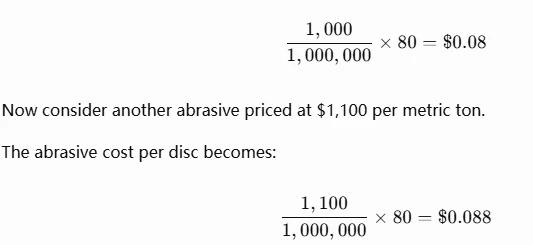
The difference is only $0.008 per disc.
For a manufacturer producing large volumes, this difference is commercially relevant.
However, it must be compared with finished-disc performance.
Compare Abrasive Cost per Cut
|
Performance Metric |
Abrasive A |
Abrasive B |
|---|---|---|
|
Abrasive Price |
$1,000/MT |
$1,100/MT |
|
Abrasive Consumption per Disc |
80 g |
80 g |
|
Abrasive Cost per Disc |
$0.080 |
$0.088 |
|
Average Cuts per Disc |
20 |
25 |
|
Abrasive Cost per Cut |
$0.00400 |
$0.00352 |
Hypothetical calculation. These figures are not actual Hengye quotations or performance test results.
Although Abrasive B costs 10% more per ton, its abrasive cost per cut is 12% lower in this example.
This illustrates why manufacturers should consider abrasive utilization rather than purchase price alone.
Include Cutting Time in the Economic Comparison
Now assume the following cutting performance.
|
Performance Metric |
Disc A |
Disc B |
|---|---|---|
|
Average Cutting Time |
20 Seconds |
17 Seconds |
|
Average Cuts per Disc |
20 |
25 |
|
Time Required for 1,000 Cuts |
5.56 Hours |
4.72 Hours |
|
Discs Required for 1,000 Cuts |
50 |
40 |
Under these hypothetical conditions, Disc B reduces active cutting time by approximately 50 minutes per 1,000 cuts and requires fewer discs.
Actual productivity improvements would also depend on handling time, disc replacement time, machine availability, and operating conditions.
Cutting Disc Cost Calculator
The following calculator demonstrates how abrasive price, disc manufacturing cost, service life, and cutting time influence operating economics.
The lowest abrasive quotation does not necessarily produce the most economical cutting disc.
A manufacturer should evaluate material price, wheel manufacturing cost, cutting speed, service life, and consistency together.


