

Two batches of white fused alumina may have the same F46 designation, similar Al₂O₃ purity, and almost identical appearances. Yet when used in grinding wheel production, they can produce noticeably different results.
One batch may provide stable pressing behavior and consistent grinding performance, while another may require production adjustments or lead to unexpected wheel wear.
One frequently overlooked reason is particle size distribution.
Unlike nominal grit size, which identifies an abrasive grade, particle size distribution describes how coarse, intermediate, and fine particles are distributed throughout the material.
For grinding wheel manufacturers, controlling particle size distribution is essential for maintaining consistent abrasive packing, wheel structure, grinding behavior, and repeatable production.
In this guide, we will explain how white fused alumina particle size distribution works, how to interpret grading reports, and what industrial buyers should check before purchasing abrasive grains in bulk.
1. What Is White Fused Alumina Particle Size Distribution?
White fused alumina (WFA), also known as white corundum or white aluminum oxide, is a synthetic abrasive produced by melting high-purity industrial alumina in an electric arc furnace.
Commercial white fused alumina commonly contains approximately 99% or more Al₂O₃ and has a Mohs hardness of around 9.
It is widely used in vitrified grinding wheels, resin-bonded abrasives, precision grinding tools, lapping, polishing, and surface treatment.
After smelting and cooling, fused alumina blocks are crushed and classified into different abrasive grain sizes.
However, crushing does not produce particles of exactly the same dimensions.
Even after screening, an abrasive grade contains particles within a defined size distribution.
Particle size distribution describes the proportion of particles falling within different size ranges.
For example, a batch of F46 white fused alumina may contain:
Relatively coarse particles within the permitted grading limits.
Intermediate particles representing the main grain fraction.
Smaller particles within the permitted fine fraction.
Oversized or undersized particles that must remain within applicable limits.
The balance between these fractions influences how the abrasive behaves during manufacturing and grinding.
Nominal Grit Size vs Particle Size Distribution
|
Comparison |
Nominal Grit Size |
Particle Size Distribution |
|---|---|---|
|
Definition |
Abrasive grade designation |
Distribution of particles across size ranges |
|
Example |
F36, F46, F60 |
Percentage retained on individual sieves |
|
Main Purpose |
Product identification |
Detailed grading evaluation |
|
Purchasing Value |
Initial product selection |
Material consistency verification |
|
Manufacturing Relevance |
General abrasive size |
Packing, structure and process consistency |
|
Quality Control |
Grade confirmation |
Batch-level inspection |
Think of nominal grit size as the product's name and particle size distribution as its detailed size profile.
Both are important, but they answer different questions.
2. Why the Same Grit Size Does Not Mean the Same Abrasive
Imagine two white fused alumina manufacturers supplying F46 abrasive grains.
Both products meet the applicable grading requirements, but their particle distributions are positioned differently within the permitted ranges.
Supplier A may have a greater proportion of particles concentrated in the central size fractions.
Supplier B may have more particles near the coarse and fine ends of the permitted distribution.
Both materials may be commercially acceptable. However, they may not behave identically in a grinding wheel formulation.
Example of Two Different Particle Distributions
|
Particle Fraction |
Abrasive A |
Abrasive B |
|---|---|---|
|
Relatively Coarse Fraction |
12% |
20% |
|
Main Intermediate Fraction |
78% |
60% |
|
Relatively Fine Fraction |
10% |
20% |
|
Total |
100% |
100% |
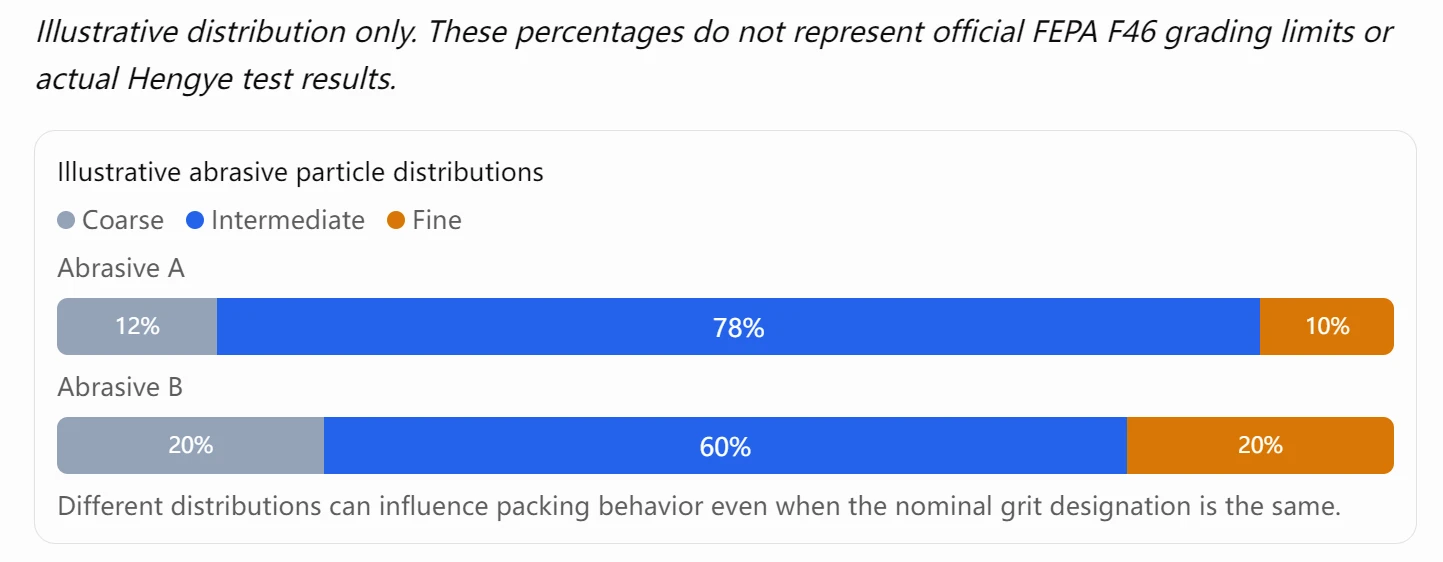
Abrasive A has a narrower illustrative distribution, while Abrasive B contains a broader mixture of particle sizes.
The broader distribution may allow smaller particles to occupy spaces between larger particles, potentially changing bulk density and packing behavior.
The narrower distribution may be beneficial for certain formulations requiring more uniform grain dimensions.
Neither distribution is automatically better.
The correct distribution is the one that matches the grinding wheel manufacturer's formulation, production process, and intended grinding application.
3. Understanding FEPA Grit Sizes and Grading Standards
One of the most common purchasing mistakes is comparing abrasive grit numbers without checking the applicable grading standard.
Several abrasive grading systems exist internationally.
FEPA F-Grit vs P-Grit
FEPA F-grit designations are commonly associated with bonded abrasives and general abrasive grain applications.
FEPA P-grit designations are primarily associated with coated abrasives.
Although both systems use numerical grit designations, their grading requirements are different.
An F80 abrasive should not automatically be treated as interchangeable with a P80 abrasive.
|
Grading System |
Typical Application |
Purchasing Consideration |
|---|---|---|
|
FEPA F-Grit |
Bonded Abrasives |
Common for Grinding Wheels |
|
FEPA P-Grit |
Coated Abrasives |
Common for Abrasive Belts and Papers |
|
ANSI |
Abrasive Products |
Confirm Applicable Standard |
|
JIS |
Abrasive and Precision Applications |
Confirm Grade and Test Method |
|
Micron Classification |
Fine Powders and Precision Processing |
Specify Distribution and Measurement Method |
When requesting a white fused alumina quotation, specify the complete grit designation rather than simply writing "46 mesh" or "80 grit."
Mesh numbers, FEPA grades, and micron classifications are not universally interchangeable.
Common White Fused Alumina Grit Sizes
|
FEPA Grade |
Relative Grain Size |
Typical Selection Direction |
|---|---|---|
|
F16–F24 |
Coarse |
Heavy Material Removal |
|
F30–F46 |
Medium-Coarse |
General Grinding and Abrasive Tool Production |
|
F54–F80 |
Medium |
Controlled Grinding Operations |
|
F90–F120 |
Medium-Fine |
Finer Grinding Applications |
|
F150–F220 |
Fine |
Fine Grinding and Surface Finishing |
|
F230 and Finer |
Microgrit |
Specialized Fine Abrasive Applications |
These application ranges are general selection references rather than mandatory operating recommendations.
The final grit selection depends on the workpiece, wheel structure, bond system, grinding conditions, and required surface finish.
For bonded abrasive macrogrits, buyers should refer to the applicable FEPA grading requirements or ISO 8486-1. Microgrits require the corresponding grading requirements and suitable measurement procedures.
4. How Particle Size Distribution Affects Grinding Wheel Manufacturing
The effect of particle size distribution begins before the grinding wheel is used.
It can influence multiple stages of the manufacturing process, including mixing, filling, pressing, curing or firing, and finished-wheel performance.
Abrasive Mixing and Bond Distribution
During grinding wheel production, abrasive grains are mixed with resin or vitrified bond materials and other formulation ingredients.
Different particle sizes have different surface-area-to-volume relationships.
For idealized particles of the same shape and material, specific surface area increases as particle diameter decreases.
This means that a greater proportion of fine particles can increase the total surface area that interacts with the bond.
Consider an idealized comparison between spherical particles with diameters of 400 μm and 200 μm.
At the same material mass, the smaller particles would have approximately twice the total surface area.
Real fused alumina grains are irregular rather than spherical, so actual values will differ. Nevertheless, the example explains why changes in particle distribution can influence bond requirements and mixing behavior.
A formulation developed for one abrasive distribution may not behave identically when the fine fraction changes.
Bulk Density and Mold Filling
Bulk density describes the mass of loose abrasive occupying a specified volume.
Particle size distribution influences how grains arrange themselves within that volume.
Smaller grains may occupy some of the spaces between larger grains, changing packing density.
This is particularly relevant for manufacturing processes that use volumetric feeding or filling systems.
Consider the following example.
|
Parameter |
Batch A |
Batch B |
|---|---|---|
|
Loose Bulk Density |
1.70 g/cm³ |
1.80 g/cm³ |
|
Filling Volume |
500 cm³ |
500 cm³ |
|
Abrasive Mass |
850 g |
900 g |
|
Mass Difference |
- |
+50 g |
Hypothetical example demonstrating volumetric filling differences.
Under these assumptions, the same filling volume contains approximately 5.9% more abrasive mass when Batch B is used.
This does not mean that a finished grinding wheel will automatically contain 5.9% more abrasive. Actual production may use mass-based dosing or other controls.
However, it illustrates why manufacturers should monitor bulk density and particle distribution together.
Pressing Behavior and Green Wheel Density
Before curing or firing, the abrasive mixture must be formed into the required wheel geometry.
Changes in grain packing can influence compaction behavior and the density of the unfired or uncured wheel.
Manufacturers may observe changes in:
Mold filling consistency.
Compaction response.
Green wheel density.
Dimensional consistency.
Material distribution within the wheel.
These effects also depend on bond content, mixing quality, pressing conditions, and other formulation variables.
If production behavior changes immediately after switching abrasive batches, particle distribution is one factor worth investigating.
Grinding Wheel Porosity
Porosity is an important characteristic of many grinding wheels.
Pores can provide space for grinding debris and facilitate coolant access under suitable operating conditions.
Particle size distribution influences the initial arrangement of abrasive grains and can therefore contribute to the resulting wheel structure.
However, final porosity is also controlled by the bond system, abrasive concentration, pore-forming materials, and manufacturing conditions.
A broader particle distribution does not necessarily produce a better or worse wheel.
Manufacturers should evaluate the complete structure against the intended application.
Grinding Performance and Surface Finish
Particle distribution can influence the number, spacing, and dimensions of abrasive cutting points.
Relatively coarse grains may contribute to more aggressive material removal, while finer grains may support finer surface finishes under appropriate grinding conditions.
Unexpected changes in particle distribution may affect grinding behavior even when the nominal grit remains unchanged.
For precision grinding applications, consistency between abrasive batches can be particularly important.
5. What Happens When White Fused Alumina Contains Too Many Coarse or Fine Particles?
Particle size distribution becomes especially important when an abrasive contains excessive coarse particles, fine particles, or unwanted dust.
These conditions can create different manufacturing and grinding challenges.
Excessive Coarse Particles
Oversized particles may create localized differences in the abrasive structure.
In certain grinding applications, unusually large particles can contribute to deeper scratches or inconsistent surface finishes.
Potential consequences include:
Increased variation in workpiece surface roughness.
Uneven abrasive distribution.
Changes in grinding forces.
Additional finishing requirements.
Increased risk of rejected workpieces.
For manufacturers producing precision grinding wheels, controlling oversized particles can be particularly important.
Excessive Fine Particles
A higher proportion of fine particles can increase the total abrasive surface area and change packing characteristics.
Depending on the formulation, this may influence bond distribution, mixing behavior, and wheel structure.
Unwanted dust should also be distinguished from the intentionally specified fine fraction.
Fine particles within the grading requirements are not necessarily contaminants. Excessive dust outside the intended specification is a separate quality concern.
Coarse Particles vs Fine Particles
|
Potential Effect |
Excessive Coarse Particles |
Excessive Fine Particles |
|---|---|---|
|
Surface Finish |
May Increase Scratch Depth |
May Change Grinding Behavior |
|
Bond Distribution |
May Create Local Variation |
May Increase Total Surface Area |
|
Abrasive Packing |
May Change Grain Arrangement |
May Fill Interparticle Spaces |
|
Grinding Efficiency |
May Alter Grinding Forces |
May Affect Cutting Characteristics |
|
Production Consistency |
Potentially Reduced |
Potentially Reduced |
|
Quality Control Priority |
Oversize Fraction Inspection |
Fine Fraction and Dust Inspection |
The objective is not to eliminate all coarse or fine particles.
It is to maintain the particle distribution required by the applicable grading standard and the customer's manufacturing process.
6. How to Read a White Fused Alumina Particle Size Distribution Report
A particle size report provides more useful purchasing information than a product label alone.
However, buyers need to understand how the results are presented.
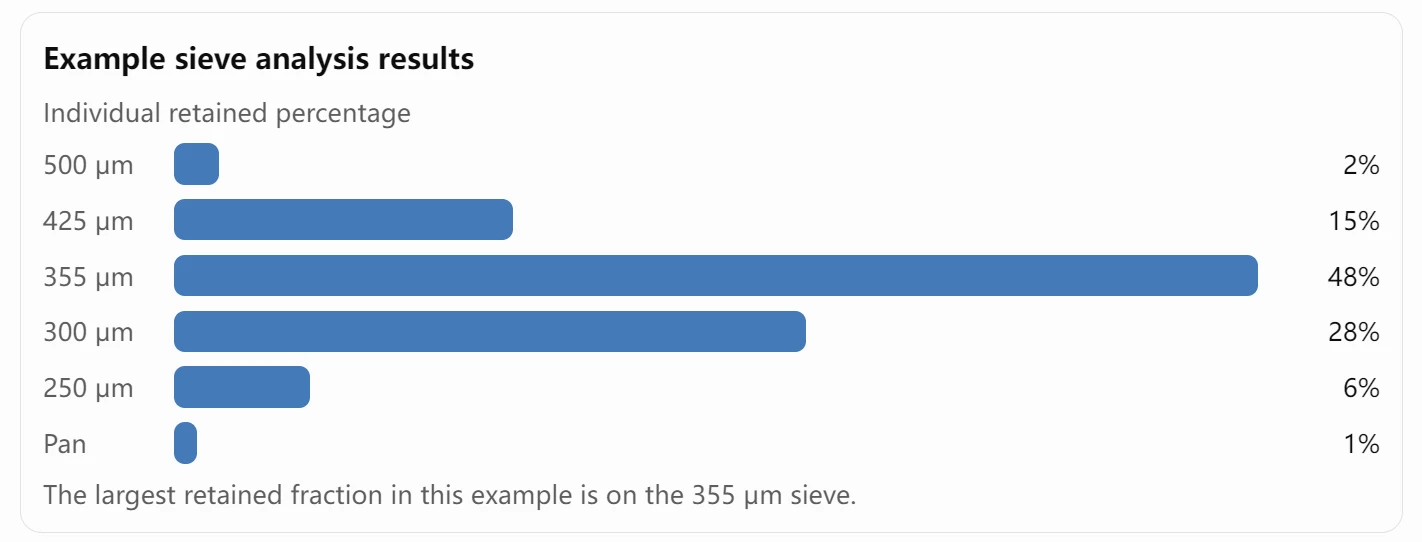
For macrogrit abrasives, sieve analysis is commonly used to determine how much material is retained on individual sieves.
Confirm the Test Standard
Check whether the report identifies:
Abrasive grade.
Applicable grading standard.
Sample or production batch number.
Sieve sizes.
Test procedure.
Inspection date.
Without this information, comparing reports from different manufacturers can be difficult.
Understand Individual and Cumulative Retained Percentages
Individual retained percentage describes the proportion of the sample retained on a particular sieve.
Cumulative retained percentage describes the combined proportion retained on that sieve and the preceding coarser sieves.
For example, consider a hypothetical 100-gram abrasive sample.
|
Sieve Opening |
Retained Mass |
Individual Retained |
Cumulative Retained |
|---|---|---|---|
|
500 μm |
2 g |
2% |
2% |
|
425 μm |
15 g |
15% |
17% |
|
355 μm |
48 g |
48% |
65% |
|
300 μm |
28 g |
28% |
93% |
|
250 μm |
6 g |
6% |
99% |
|
Pan |
1 g |
1% |
100% |
This example demonstrates how sieve analysis results are calculated. It does not represent an official FEPA grade specification.
Compare the Results with the Agreed Specification
A particle size report should be evaluated against the applicable grading requirements.
For critical grinding wheel applications, manufacturers may establish additional internal acceptance limits within the applicable standard.
These limits should be based on validated production requirements.
A supplier should not be rejected simply because its distribution differs from another supplier's distribution if both meet the agreed requirements and perform acceptably.
Understand D10, D50, and D90 for Fine Abrasive Powders
For fine white fused alumina powders, particle size reports may include D10, D50, and D90 values.
|
Parameter |
Meaning |
|---|---|
|
D10 |
10% of the measured distribution is below this particle size |
|
D50 |
Median particle size |
|
D90 |
90% of the measured distribution is below this particle size |
|
Distribution Span |
A relative measure of distribution width |
The distribution basis, such as volume or number, and the measurement method must be identified.
For laser diffraction measurements, results are commonly reported on a volume basis.
Consider two hypothetical fine white fused alumina powders.
|
Parameter |
Powder A |
Powder B |
|---|---|---|
|
D10 |
8 μm |
4 μm |
|
D50 |
15 μm |
15 μm |
|
D90 |
24 μm |
35 μm |
|
Distribution Span |
1.07 |
2.07 |
Although both powders have the same D50 value, Powder B has a considerably broader distribution.
This demonstrates why purchasing fine white fused alumina based only on median particle size may be insufficient.
A broader distribution is not necessarily undesirable, but it should be compatible with the intended grinding, lapping, polishing, or manufacturing application.
7. How White Fused Alumina Manufacturers Control Particle Size
Particle size consistency depends on the complete manufacturing and processing system.
A manufacturer cannot reliably achieve consistent grading through final inspection alone. Quality must be controlled throughout production.
Raw Material Selection and Smelting
White fused alumina is produced from industrial alumina through high-temperature electric arc furnace smelting.
Raw material quality and smelting conditions influence the composition and characteristics of the resulting fused material.
Although smelting does not directly determine the final commercial grit size, it establishes the material that will subsequently undergo crushing and classification.
Controlled Crushing
After cooling, fused alumina blocks are crushed into smaller particles.
Crushing equipment and operating conditions influence both particle dimensions and grain morphology.
Poorly controlled crushing may generate excessive unwanted fines or an undesirable proportion of elongated particles.
Grain Shaping
Grain shaping can modify particle morphology before final classification.
For applicable fused alumina grades, Hengye uses crushing equipment, double-roller processing, and Barmac shaping technology.
These processes help control grain morphology and support more consistent physical characteristics.
Grain shaping is particularly relevant when customers have specific bulk density or particle shape requirements.
Precision Screening
Screening is one of the most important stages for controlling macrogrit particle size distribution.
Abrasive particles are separated into size fractions using appropriate screening equipment.
Screening performance can be influenced by screen condition, feed rate, particle shape, and equipment settings.
Regular inspection and process control are therefore important for maintaining consistent grading.
Magnetic Separation
Magnetic separation helps control certain unwanted magnetic contaminants introduced during processing.
Although magnetic separation is not a particle grading operation, it forms part of the overall abrasive quality-control system.
Dry-Washing and Dust Removal
Crushing and material handling can generate unwanted fine dust.
Hengye uses dry-washing and dust-removal processes for applicable fused alumina products to help control unwanted fine material.
This is particularly relevant for customers requiring clean abrasive grains for subsequent manufacturing processes.
Final Particle Size Inspection
Finished abrasive grains should be inspected against the applicable grading requirements.
Hengye performs particle size analysis, bulk density testing, and elemental analysis for relevant fused alumina products.
These inspections help customers evaluate chemical and physical characteristics before purchasing.
|
Production Process |
Main Quality Objective |
Buyer Benefit |
|---|---|---|
|
Raw Material Selection |
Composition Control |
More Predictable Material Chemistry |
|
Smelting |
Fused Alumina Formation |
Suitable Base Abrasive Characteristics |
|
Controlled Crushing |
Particle Size Reduction |
Improved Processing Control |
|
Barmac Shaping |
Grain Morphology Control |
More Controlled Packing Characteristics |
|
Precision Screening |
Particle Classification |
Consistent Grit Distribution |
|
Magnetic Separation |
Magnetic Contaminant Control |
Improved Material Cleanliness |
|
Dry-Washing |
Unwanted Dust Removal |
Cleaner Abrasive Grains |
|
Final Inspection |
Specification Verification |
Better Purchasing Transparency |
For industrial buyers, the value of these processes should ultimately be demonstrated through inspection results and application testing.
8. How to Identify Particle Size-Related Grinding Wheel Production Problems
When grinding wheel manufacturers experience production problems, changing the abrasive supplier is not always the correct first response.
The problem may originate from the abrasive, bond formulation, mixing procedure, pressing conditions, firing process, or grinding parameters.
A structured troubleshooting process helps identify the actual cause.
Grinding Wheel Troubleshooting Guide
|
Production Problem |
Possible Abrasive-Related Cause |
Other Factors to Investigate |
|---|---|---|
|
Inconsistent Mold Filling |
Changes in Bulk Density or Distribution |
Feeding Equipment |
|
Uneven Mixing |
Excessive Fines or Grain Variation |
Mixing Time and Bond Condition |
|
Variable Green Wheel Density |
Changes in Particle Packing |
Pressing Pressure |
|
Unexpected Wheel Wear |
Grain Distribution or Friability Changes |
Bond Hardness and Grinding Pressure |
|
Deep Surface Scratches |
Oversized Particles |
Dressing and Workpiece Contamination |
|
Reduced Grinding Efficiency |
Unsuitable Grain Distribution |
Wheel Speed and Dressing Conditions |
|
Variable Surface Finish |
Batch-to-Batch Grain Variation |
Machine Condition and Coolant |
|
Increased Rejection Rate |
Abrasive Specification Variation |
Curing, Firing and Handling |
These are potential causes rather than definitive diagnoses.
A Four-Step Troubleshooting Method
Identify when the problem started.
Determine whether the issue appeared after receiving a new abrasive batch, changing suppliers, adjusting equipment, or modifying the formulation.
Compare the current abrasive with an approved reference sample.
Check particle size distribution, bulk density, chemical composition, and grain morphology using consistent test methods.
Conduct a controlled production comparison.
Keep other manufacturing variables unchanged wherever practical.
Evaluate finished-wheel performance.
Compare the resulting wheels using appropriate performance and safety testing procedures.
If the problem follows the abrasive batch under controlled conditions, further investigation of the material is justified.
If the problem remains unchanged when the abrasive is replaced, other production variables may be responsible.
This approach can prevent unnecessary supplier changes and help manufacturers identify the actual source of production variation.
9. How Particle Size Consistency Affects Grinding Wheel Manufacturing Costs
White fused alumina price is an important purchasing consideration, especially for manufacturers consuming large quantities every month.
However, the economic value of an abrasive cannot be determined by its price per ton alone.
Abrasive consistency may influence production adjustments, inspection requirements, rejection rates, and finished-wheel performance.
The Hidden Cost of Abrasive Variation
Consider a hypothetical grinding wheel factory with the following production conditions.
|
Production Parameter |
Value |
|---|---|
|
Monthly Production |
200,000 Wheels |
|
Abrasive Consumption per Wheel |
100 g |
|
Monthly Abrasive Consumption |
20 MT |
|
Assumed Net Loss per Rejected Wheel |
$0.60 |
The manufacturer is comparing two white fused alumina suppliers.
|
Cost Factor |
Supplier A |
Supplier B |
|---|---|---|
|
White Fused Alumina Price |
$1,100/MT |
$1,140/MT |
|
Monthly Abrasive Cost |
$22,000 |
$22,800 |
|
Finished-Wheel Rejection Rate |
2.5% |
1.5% |
|
Monthly Rejected Wheels |
5,000 |
3,000 |
|
Additional Rejection Loss |
$3,000 |
$1,800 |
|
Combined Evaluated Cost |
$25,000 |
$24,600 |
Hypothetical economic example, not actual market quotations, Hengye performance data, or customer results. The calculation assumes the rejection-rate difference is attributable to abrasive quality and that the additional rejection loss excludes abrasive expenditure already counted.
10. How to Establish a White Fused Alumina Purchasing Specification
A detailed purchasing specification helps grinding wheel manufacturers communicate their requirements and compare suppliers on an equivalent basis.
Instead of requesting only "99% white fused alumina F46," buyers should identify the characteristics that influence their manufacturing process.
Recommended Purchasing Specification
|
Specification Item |
Purchasing Requirement |
|---|---|
|
Product Name |
White Fused Alumina |
|
Application |
Vitrified or Resin-Bonded Grinding Wheels |
|
Abrasive Grade |
F46 or Customer-Specified Grade |
|
Grading Standard |
Applicable FEPA / ISO Standard |
|
Al₂O₃ Content |
Agreed Minimum |
|
Na₂O Content |
Agreed Maximum |
|
Fe₂O₃ Content |
Agreed Maximum |
|
Particle Size Distribution |
Standard or Customer-Approved Limits |
|
Bulk Density |
Customer-Approved Range |
|
Grain Morphology |
Approved Reference or Defined Requirement |
|
Magnetic Material |
Agreed Limit if Required |
|
Moisture |
Agreed Limit if Required |
|
Packaging |
Confirmed Before Ordering |
|
Quality Documentation |
Applicable Inspection Reports |
|
Batch Identification |
Required |
|
Sample Approval |
Before Commercial Supply |
This specification should be adjusted according to the actual application.
A manufacturer producing general-purpose grinding wheels may not need the same acceptance limits as a manufacturer producing precision grinding tools.
How to Qualify a New White Fused Alumina Supplier
A practical supplier qualification process should include four stages.
Technical confirmation
Confirm the chemical composition, grit designation, grading standard, and relevant physical properties.
Representative sample inspection
Compare the new abrasive with the existing approved material using consistent inspection procedures.
Production trial
Evaluate the abrasive in the intended grinding wheel formulation and manufacturing process.
Commercial batch verification
Confirm that subsequent commercial shipments remain consistent with the approved material and agreed specifications.
Where practical, retain reference samples and inspection records for future comparisons.
This creates a more reliable basis for long-term purchasing than approving a supplier solely on price and chemical purity.
11. Why Source White Fused Alumina from Hengye?
For grinding wheel manufacturers, the challenge is not simply finding a supplier capable of producing high-purity white fused alumina.
The challenge is finding an abrasive manufacturer capable of supporting consistent material requirements over repeated orders.
Hengye supplies white fused alumina and brown fused alumina for industrial abrasive manufacturing, with particular attention to grain processing, particle classification, and quality inspection.
Controlled Grain Processing
Our relevant fused alumina processing operations include crushing, double-roller processing, and Barmac grain shaping.
These processes help control particle morphology and support specific customer requirements.
Precision Particle Classification
Precision screening helps maintain the required grit distribution.
For customers producing grinding wheels, particle size consistency is an important consideration when evaluating repeat orders.
Magnetic Separation and Dust Removal
Magnetic separation and dry-washing processes help control certain unwanted contaminants and fine dust in applicable fused alumina products.
These operations support cleaner abrasive materials for subsequent industrial processing.
Quality Inspection and Technical Communication
Hengye performs relevant inspections, including:
Particle size analysis.
Bulk density testing.
Elemental analysis.
Applicable chemical and physical specification verification.
Customers can discuss required inspection documents, product specifications, representative samples, and purchasing requirements before placing commercial orders.
Application-Oriented Material Selection
Different grinding wheel manufacturers have different material requirements.
Rather than selecting white fused alumina solely according to grit number, we encourage customers to provide information about their bond system, workpiece, grinding application, and existing abrasive specification.
This helps establish a more meaningful basis for material selection and quotation.


