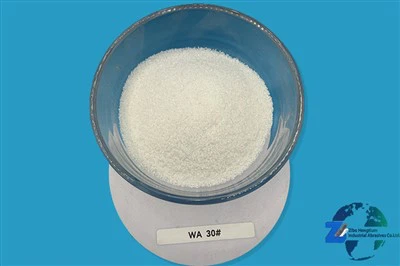
The shape of brown corundum particles significantly impacts the performance of refractories. As a supplier of brown corundum for refractory applications, I have witnessed firsthand how different particle shapes can lead to varying outcomes in refractory performance. In this blog, I will delve into the effects of brown corundum particle shape on refractory performance and why it matters for industries relying on high - quality refractories.
Overview of Brown Corundum and Refractories
Brown corundum, also known as brown fused alumina, is a widely used abrasive and refractory material. It is produced by fusing bauxite, anthracite, and iron filings in an electric arc furnace at high temperatures. The result is a hard, durable material with excellent thermal and mechanical properties. Refractories are materials that can withstand high temperatures without significant deformation or chemical change, and they are crucial in industries such as steelmaking, cement production, and glass manufacturing.


Particle Shape Classification
The particle shape of brown corundum can be classified into several categories: angular, sub - angular, rounded, and irregular. Angular particles have sharp edges and corners, which are typically formed during the crushing and screening process. Sub - angular particles have somewhat rounded edges but still retain a certain degree of angularity. Rounded particles have a smooth, spherical appearance, often resulting from processes like attrition or shaping treatments. Irregular particles do not conform to a specific shape pattern.
Effects on Refractory Density
One of the primary ways particle shape affects refractory performance is through its impact on density. Angular particles tend to pack less efficiently than rounded particles. When angular brown corundum particles are used in a refractory mix, there are more voids between the particles. This leads to a lower bulk density of the refractory material. On the other hand, rounded particles can pack more closely together, increasing the bulk density of the refractory. A higher density refractory generally has better mechanical strength and lower porosity, which in turn enhances its resistance to corrosion and thermal shock.
Influence on Refractory Strength
The shape of brown corundum particles also plays a significant role in determining the strength of refractories. Angular particles can provide better interlocking within the refractory matrix. The sharp edges and corners of angular particles can create a mechanical bond, which helps to resist cracking and spalling under stress. For example, in a refractory lining subjected to high - pressure or thermal cycling, the interlocking of angular particles can enhance the overall structural integrity of the material.
In contrast, rounded particles may not offer the same level of interlocking. However, they can distribute stress more evenly throughout the refractory. This can be beneficial in applications where the refractory is exposed to uniform stress fields. The choice between angular and rounded particles depends on the specific requirements of the refractory application, such as the type of stress it will encounter.
Impact on Refractory Thermal Conductivity
Thermal conductivity is an important property for refractories, especially in applications where heat transfer needs to be controlled. The particle shape of brown corundum can influence thermal conductivity. Angular particles, due to their irregular shape, create more tortuous paths for heat flow within the refractory. This can result in lower thermal conductivity compared to refractories made with rounded particles.
In some cases, lower thermal conductivity is desirable, such as in insulation refractories. By using angular brown corundum particles, the refractory can effectively reduce heat loss. Conversely, in applications where efficient heat transfer is required, rounded particles may be preferred as they can provide a more direct path for heat conduction.
Effects on Refractory Workability
Workability refers to the ease with which a refractory material can be mixed, shaped, and installed. The particle shape of brown corundum has a notable impact on workability. Angular particles can cause more friction during mixing and shaping processes. This may require more energy to achieve a homogeneous mixture and can also make it more difficult to shape the refractory into the desired form.
Rounded particles, with their smooth surfaces, offer better flowability and lower friction. This makes the refractory mix easier to handle and shape. For example, in the casting of refractory bricks, a mix containing rounded brown corundum particles will flow more easily into the mold, resulting in a more uniform and defect - free product.
Considerations for Different Refractory Applications
In the steelmaking industry, where refractories are exposed to extremely high temperatures and corrosive slags, the choice of brown corundum particle shape is critical. Angular particles are often preferred for lining applications in steel ladles and furnaces. Their interlocking ability can enhance the refractory's resistance to mechanical and thermal stress, while their relatively lower thermal conductivity can help reduce heat loss.
In the cement production industry, refractories are used in kilns and pre - heaters. Here, the combination of high temperatures and abrasive materials requires refractories with good wear resistance. Rounded particles may be more suitable in some areas of the kiln where workability is crucial for proper installation. However, angular particles can also be used in areas where high - strength and corrosion resistance are the primary concerns.
Product Offerings and Their Particle Shapes
As a supplier of brown corundum for refractory applications, we offer a range of products with different particle shapes to meet the diverse needs of our customers. Our Grade 2 brown fused alumina has a well - controlled particle shape, which is optimized for applications requiring a balance between strength and workability.
Our Brown Fused Alumina Sandblasting product, although primarily used for sandblasting, also has properties that make it suitable for certain refractory applications. The particle shape of this product can enhance the wear resistance of refractories when used in appropriate mixtures.
For dedicated refractory applications, our Brown Corundum Refractory product offers a variety of particle shapes. We can provide angular particles for high - strength applications and rounded particles for better workability, depending on the customer's requirements.
Conclusion
In conclusion, the particle shape of brown corundum has far - reaching effects on refractory performance. It influences density, strength, thermal conductivity, and workability, all of which are crucial factors in determining the suitability of a refractory for a particular application. As a supplier, we understand the importance of these effects and are committed to providing high - quality brown corundum products with the right particle shapes for our customers' needs.
If you are in the market for brown corundum for refractory applications and want to discuss your specific requirements or explore our product range further, we encourage you to reach out to us for a procurement negotiation. Our team of experts is ready to provide you with detailed information and support to ensure you get the best - fitting solution for your refractory needs.
References
- Smith, J. K. (20XX). "The Role of Particle Shape in Refractory Materials." Journal of Refractory Technology.
- Johnson, R. L. (20XX). "Effects of Abrasive Particle Shape on Material Properties." International Journal of Abrasive Technology.
- Lee, S. H. et al. (20XX). "Thermal and Mechanical Properties of Refractories with Different Brown Corundum Particle Shapes." Asian Journal of Refractory Science and Technology.